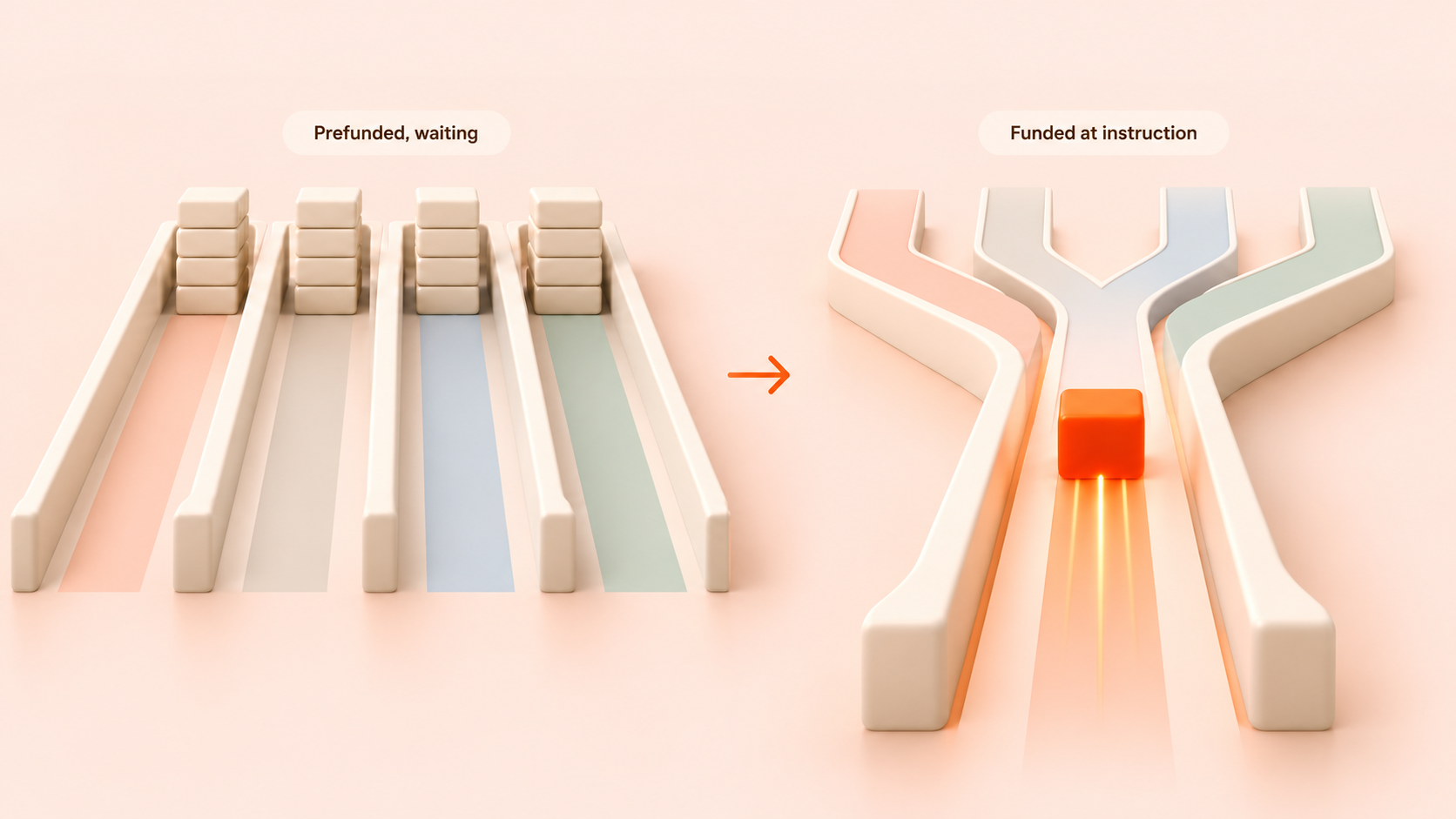
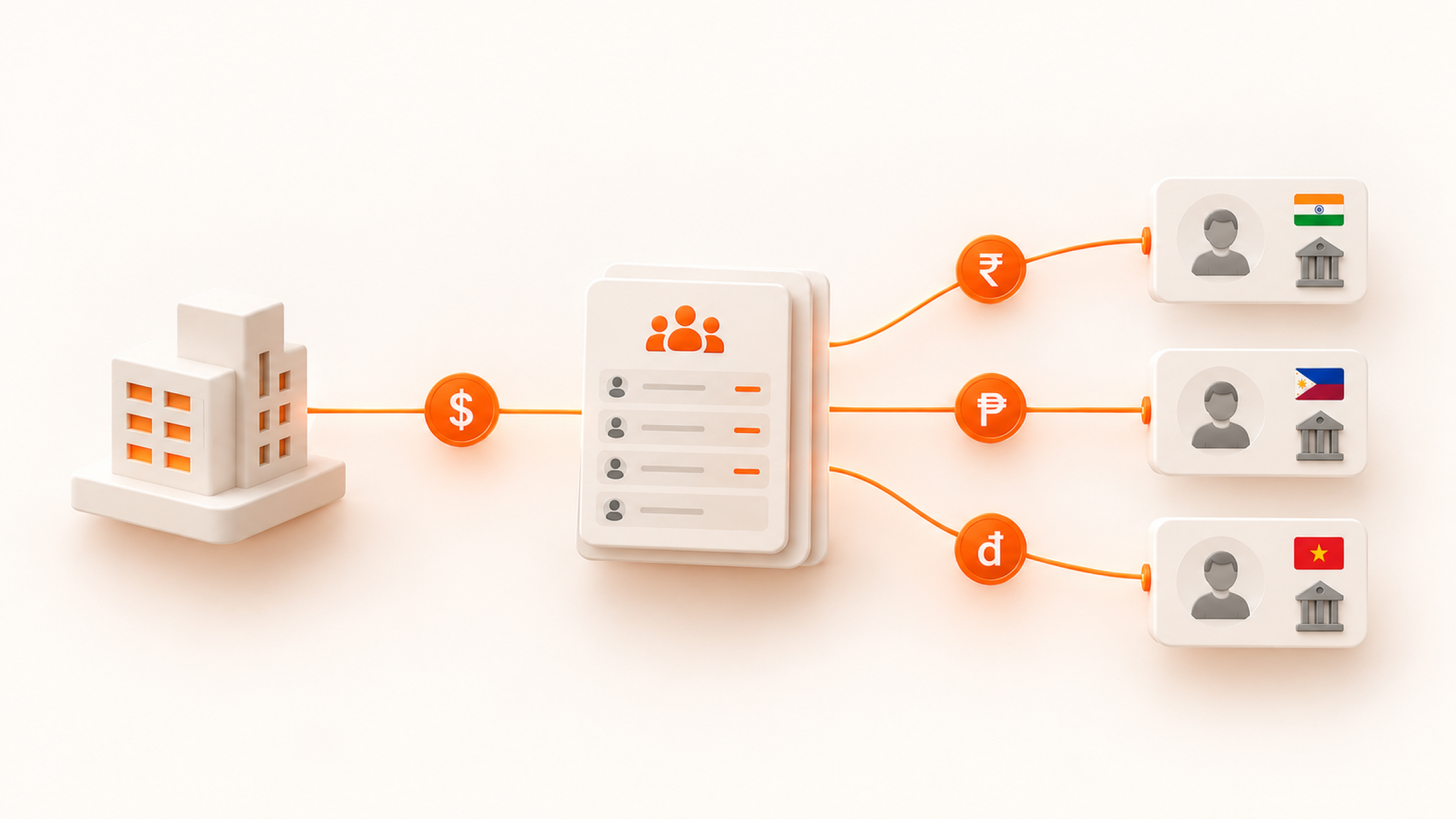
Prefunding is the largest idle line on a money transfer operator's balance sheet. An MTO paying $500,000 a day across five corridors on T+2 settlement holds roughly $1,000,000 in destination accounts at all times, costing about $80,000 a year to carry. zPayments removes the standing balance: operators fund each payout in USDC at the moment they instruct it, and a licensed partner inside the corridor pays the beneficiary against a pre-allocated facility.
The balance that is wired before the business arrives
Lets try to understand this through an example. Arjun runs settlement at a money transfer operator licensed in Singapore. The business pays into five markets across South and Southeast Asia, and on any Monday morning he can state the exact balance sitting in each one, because he wired it there weeks ago.
None of that money has been earned yet. It sits in destination accounts so that when a customer sends, the local partner can pay the beneficiary the same hour. The balances move only when they are drawn down and topped up again.
What nostro prefunding is, and why MTOs do it
Prefunding exists because there is no shared real-time ledger between banks in different countries. The settlement instruction and the customer's money travel on separate clocks, so one party has to be in funds first. For an MTO, that party is the MTO.
The account holding it is a nostro. A bank or payout partner holds it on the operator's behalf in local currency, and the same balance seen from their side is a vostro. The BIS Annual Economic Report 2025 describes the arrangement plainly: commercial banks transact through a network of nostro and vostro accounts. Every corridor added means another one.
What the standing balance costs
The arithmetic is simpler than the industry makes it look.
Prefunded balance = daily payout volume x settlement lag in days
Annual carry = prefunded balance x cost of capital
Arjun's business pays out $500,000 a day and the partner settles on T+2. Two days of volume sit in position at any moment, so roughly $1,000,000 is prefunded. At an 8% cost of capital, the carry is $80,000 a year. And the shape holds at any volume: the balance scales with how slowly the partner settles, not with how well the business sells.
Three costs sit beyond the carry.
FX exposure between initiation and settlement. The customer is quoted a rate at initiation and the payout is funded later. Everything in between is the operator's risk. The CPMI puts workable haircuts at not more than 1% for stable currency pairs over one day, around 6% for the most volatile currency against the euro, and about 50% higher again across time zones. That is the scale of buffer the exposure demands.
The position running dry. When a prefunded balance empties mid-cycle, payouts stop. Customers are already watching a transaction that is not moving, and operations is wiring funds under pressure.
Reconciliation. Every corridor is a separate balance, a separate statement and a separate set of breaks. The cost is headcount, and it scales linearly with corridors.
Larger system-wide figures circulate for this problem, and they are worth treating carefully. The CPMI, which owns this question for the G20, states in its 2022 report on liquidity bridges that the costs of fragmented liquidity holdings are "difficult to quantify," and publishes no aggregate. An operator's own balance is the number that matters, and the formula above returns it exactly.
Why prefunding has got harder
The network being prefunded into has been shrinking for over a decade.
The BIS and CPMI reported in December 2021 that correspondent banking relationships fell 4% in 2020, a cumulative contraction of about 25% between 2011 and 2020. Over the same year, cross-border payment volume rose 2% and value rose 7%. More payments, fewer places to route them. Emerging market corridors took the worst of it, which is where MTOs operate.
Fewer correspondents means fewer partner options, a weaker negotiating position on settlement terms, and longer settlement lags. Longer lag means a larger prefunded balance. The problem compounds.
The three ways to settle with a payout partner
Before the stablecoin question there is an older one. There are three ways an operator can settle with a payout partner, and most end up on the first because the other two are gated.
Prefunded settlement. The operator places funds with the partner in advance. The partner pays out against that balance and the operator tops it up. Simple, available to anyone, and the most capital-hungry of the three.
Net settlement. Operator and partner net obligations over a period, then one party wires the difference. Far more efficient, and it requires a credit relationship with the partner. New operators rarely qualify.
Real-time gross settlement. Each transaction settles on its own instruction, which removes settlement-period risk entirely. It is operationally demanding, and access runs through central bank infrastructure.
The pattern worth noticing is that the efficient options are the gated ones. Net settlement needs credit an operator has to earn over years. RTGS access needs a licence most operators do not hold.
Per-transaction funding settled in stablecoins is a fourth option. It behaves like the third, settling against each instruction rather than against a standing balance, without requiring the operator to be a bank to reach it.
What has to be true to replace it
Before naming the solution lets understand that per-transaction funding is an improvement only if it removes the standing balance rather than relocating it onto the operator in a new form.
For that to happen, four things have to hold. The funding leg has to settle in minutes, so dollars arrive when the payout is created rather than ahead of forecast volume. The rate has to be fixed before authorisation, so the FX exposure window closes instead of moving. Destination liquidity has to be carried by a licensed party inside the corridor, so the operator is not the one holding position in five markets. And corridor coverage has to arrive as licensed capability, so adding a market is a configuration change rather than a banking relationship to source.
The CPMI examined the first of these directly in its October 2023 report on stablecoin arrangements, finding that such arrangements could reduce "funding needs associated with pre- or over-funding accounts along the chain," because fewer links in the chain reduce funding needs, on the condition that a common platform across jurisdictions actually reduces the number of intermediaries.
That condition is the product question, and it is what zPayments is built to answer.
How zPayments replaces prefunding
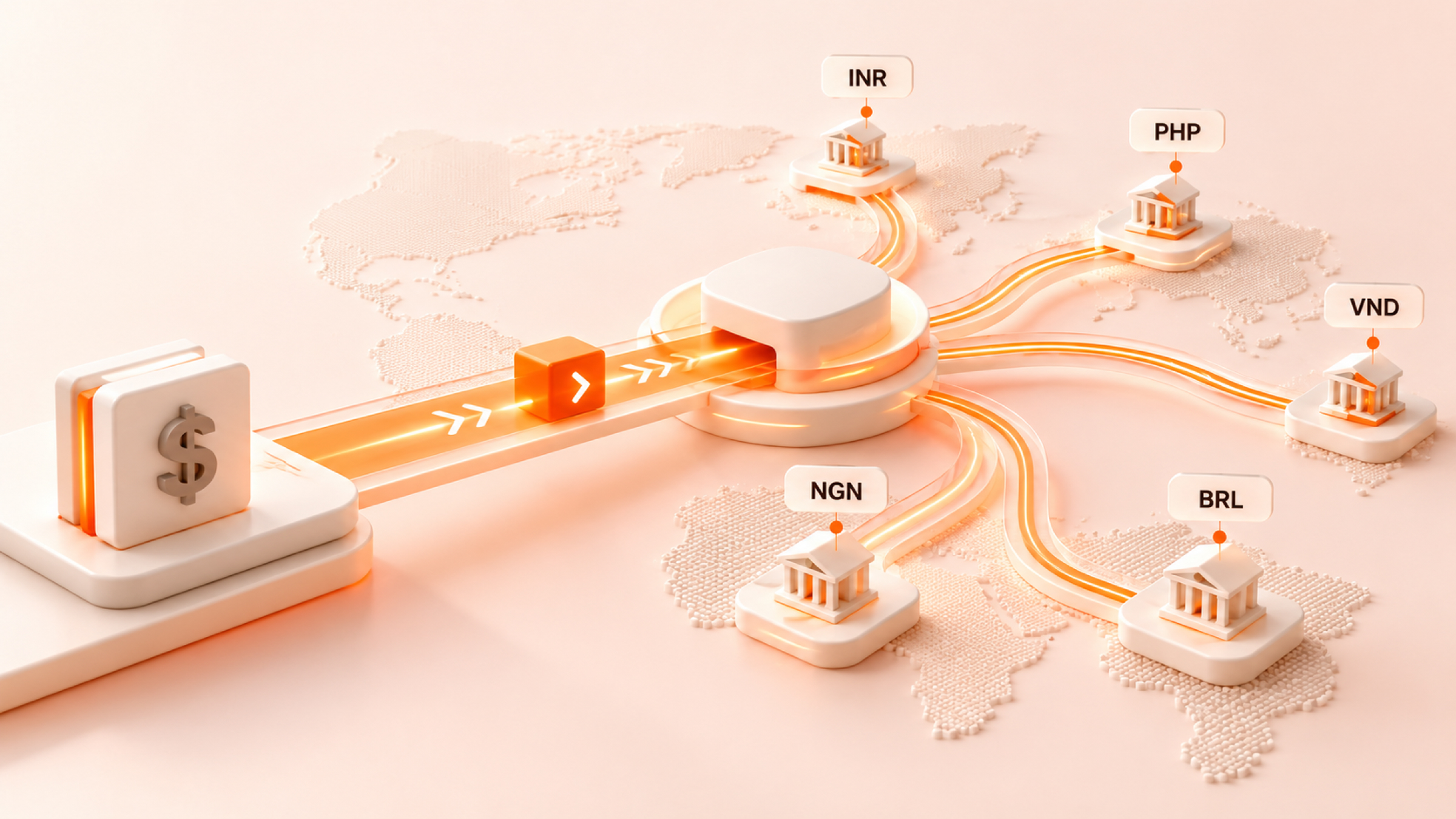
zPayments runs a postfunding model. The operator funds in USDC against the payouts being made, the funds are forwarded against a pre-allocated facility on a regulated local payout rail, and the partner pays the beneficiary against that balance. The destination position sits with the platform and its licensed partner, not on the operator's balance sheet.
It maps onto the four requirements in order.
Funding settles in minutes. USDC arrives against the payout being instructed, not against next quarter's corridor forecast. The balance becomes available once the payout partner confirms receipt.
The rate is fixed before authorisation. The quote shows the rate with the FX fee inside it, the local network commission itemised separately, and the exact amount the beneficiary receives, before anything is committed. There is no platform access or subscription fee.
Destination liquidity is carried inside the corridor. Payouts execute through licensed partners in each market, with routing across 80+ bank and settlement partners selected on FX, fee and speed. One KYB covers all of them.
Coverage arrives as licensed capability. zPayments delivers stablecoin payouts to 171 countries. Zoth Payments Limited is registered with FINTRAC as a money services business (C10001622). Adding a corridor is a configuration change once onboarding is complete.
Replay Arjun's Monday on that model. No balances wired weeks ahead into five markets. One rate per payout, fixed before he authorises it. One KYB behind every corridor he pays into. The capital that was sitting in destination accounts stays on his own balance sheet until the moment a customer actually sends.
The payout, from the operator's seat
What happens on a zPayments payout, in the order it appears.
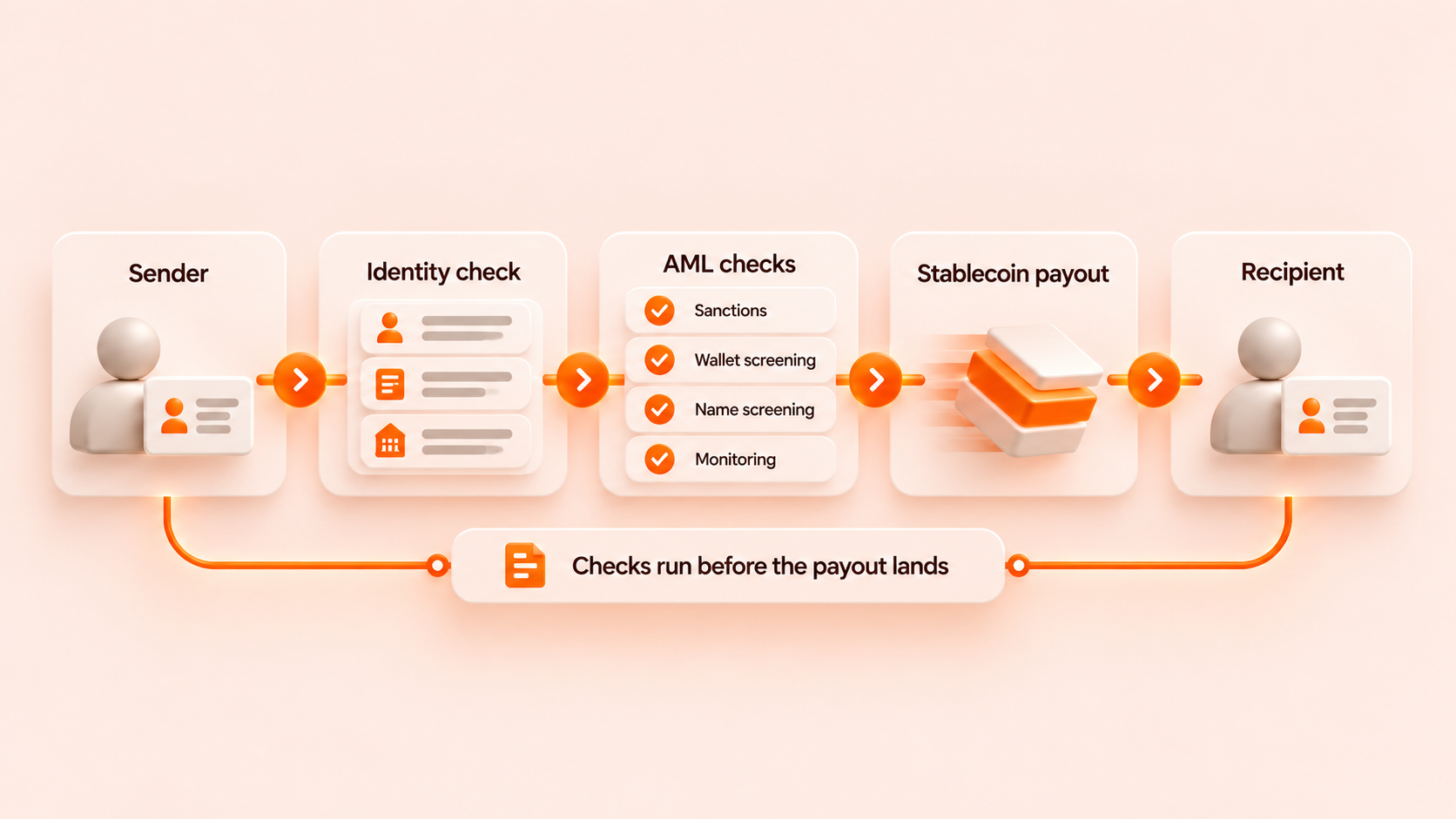
One KYB, once. The business is verified a single time. The funding wallet is recorded during verification, and only that wallet can fund the account.
Funding in USDC against payouts being made. Between deposit and payout the USDC is held by Zoth in MPC custody with 3-of-5 signing, in a segregated vault operated on ForDefi. zPayments is custodial, and the custody model is published.
A quote before commitment. Amount, source of funds and purpose in. Rate, itemised commission and beneficiary receive amount out.
An operator reviews every payout before it reaches the rail. The reviewer is never the person who created it. This is the maker-checker control.
Execution through a licensed partner inside the corridor, tracked through to delivery, with every payout, status update and compliance file landing in one auditable ledger.
The full flow, including balance and transaction states and failed-payout handling, is published in Core Flows of zPayments.
One corridor, side by side
Illustrative figures, with the arithmetic exposed.
|
Prefunded model |
zPayments |
| Daily payout volume |
$100,000 |
$100,000 |
| Settlement lag |
T+2 |
Funded at instruction |
| Capital in position |
$200,000 |
Under one day of volume, minutes on instant corridors |
| Annual carry at 8% |
$16,000 |
Under $8,000, near zero on instant corridors |
| FX exposure window |
Initiation to settlement |
Closed at quote |
| Destination liquidity |
Operator's to fund |
Carried by the licensed partner |
| Reconciliation |
One balance per corridor |
One auditable ledger |
| Corridors added by |
Sourcing a banking relationship |
Configuration, after one KYB |
Across five corridors at this volume, the carry released runs to roughly $40,000 to $80,000 a year before counting reconciliation headcount or the cost of a stalled payout. Live rates and settlement times for every supported corridor are published on the zFX rates page, refreshed every 60 seconds.
What an operator still owns
Two things do not transfer, and no provider should claim otherwise.
Regulatory obligations stay with the operator. Screening, Travel Rule handling and monitoring run inside the platform. The operator's own licensing and reporting duties remain the operator's.
The destination leg sets the clock. Swift's data is sharp on this: 90% of cross-border payments reach the destination bank within an hour, but only 43% reach the end customer in that time, and around 80% of total processing time sits in the last mile. The FSB's 2025 progress report records less than 45% of B2B and B2P cross-border payments settling within one business day, against a G20 target of 75% within one hour by end-2027. On zPayments, settlement is instant across supported corridors and next business day where the local rail clears on a cycle, with the cutoff stated before sending. The underlying mechanism is covered in why international payments take days.
Four questions to run against your own corridors
Ten minutes, four answers.
- What is the standing balance across all destination accounts right now? Multiply daily volume by settlement lag. That figure is the capital the business is lending to its own payout network.
- What did the last dry position cost? Count the stalled payouts, the emergency wire and the support volume, not just the funding gap.
- How many separate balances and statements does month-end reconciliation touch? One per corridor means reconciliation cost scales with growth.
- What would it take to open a sixth corridor tomorrow? If the answer is a banking relationship rather than a configuration change, the balance sheet is the constraint on expansion.
Check your corridor
Live rates, fulfilment mode and settlement times for every supported corridor, refreshed every 60 seconds, with no sign-up.
Book a zPayments walkthrough on your own corridors today.