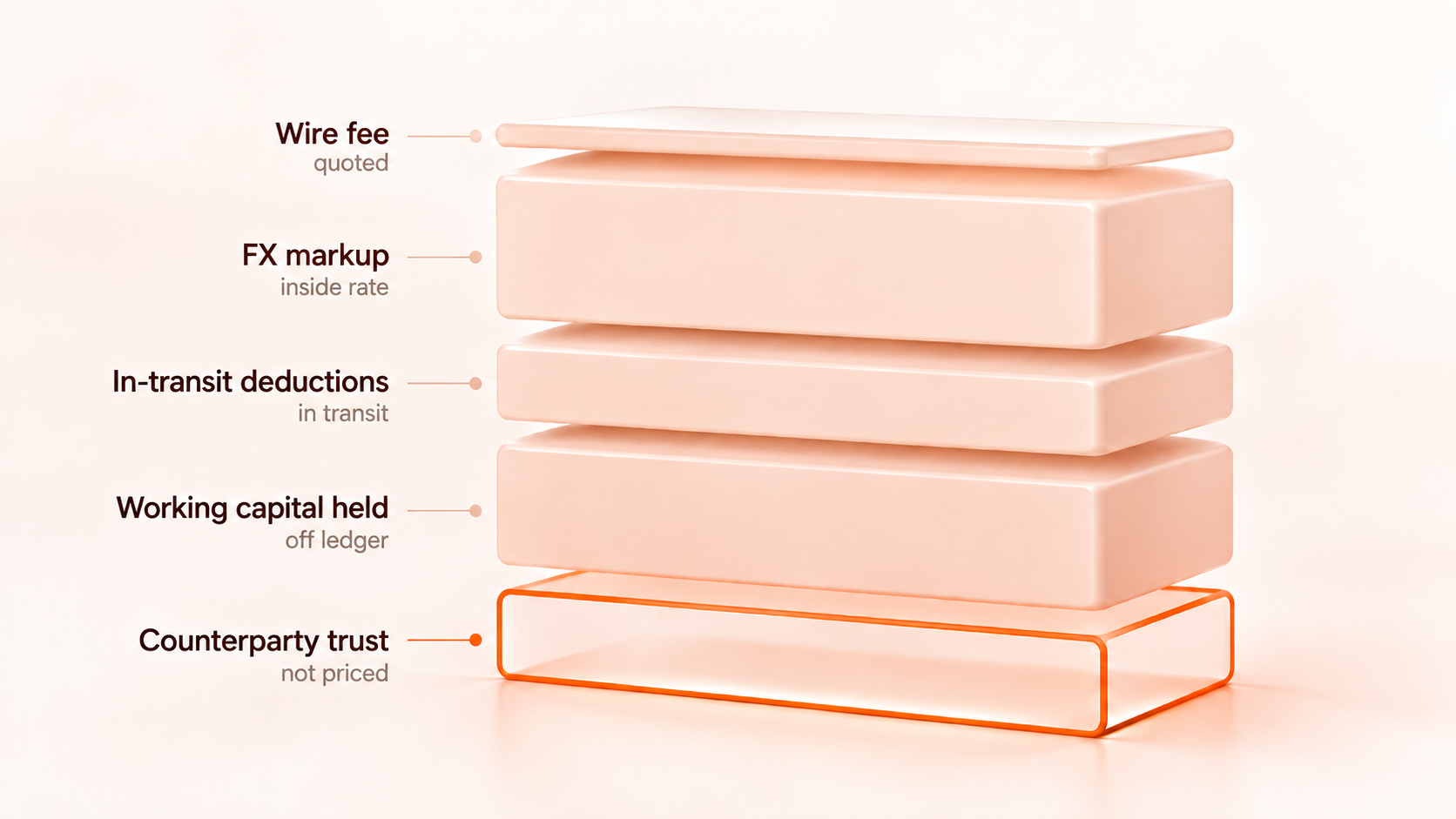
Ask a finance team what an international payout costs and most will name the wire fee, because it's the only figure that arrives with a label on it.
The other 4 are bigger and harder to see. The markup sits inside a rate. The deductions happen to money already in transit. The capital cost never touches the payments ledger at all. And the trust cost isn't a number until the day a supplier asks you to prepay the next order.
So the honest way to answer the question is to run the same payment 3 ways and compare what lands, not what gets charged.
What does the data say a payout actually costs?
2 benchmarks get quoted in this market but only one of them is about business payments.
The World Bank's Remittance Prices Worldwide database is the famous one. It reports a global average of 6.49%, and it measures the cost of sending $200 to a personal recipient. It's a consumer instrument. Apply it to a 6-figure supplier payment and you overstate the fee and understate everything else, because fixed charges shrink as a share of a large payment while the markup scales with it.
The benchmark that fits a business payout comes from FSB monitoring under the G20 roadmap. Its 2024 survey of payment providers found B2B costs for small and medium firms averaged 1.6%, with B2P, P2B and P2P all running above 2%, against a G20 target of 1% by the end of 2027.
Then there's the payment size where the data just stops. The FSB defines wholesale as anything above $100,000, and it deliberately sets no cost target for that segment. Pricing there is individually negotiated, often bundled with other services, and too opaque to average across the market.
Sit with that for a second. For payments at the size most businesses actually make, the body responsible for measuring cross-border payment costs declined to publish a benchmark, because the market doesn't produce one.
How long does the money actually take?
The G20 target is 75% of cross-border payments reaching the recipient within 1 hour, and the rest within 1 business day.
Federal Reserve staff reported in August 2026 that in 2025 the global figure was 54.4% within an hour and 76.3% within a day. Payments sent from the US did a little better, at 61.4% and 79.5%. All 4 numbers sit below target.
Turn the day-one figure over. Roughly a quarter of cross-border payments still aren't with the recipient a full business day after they left. That quarter is where the phone call comes from.
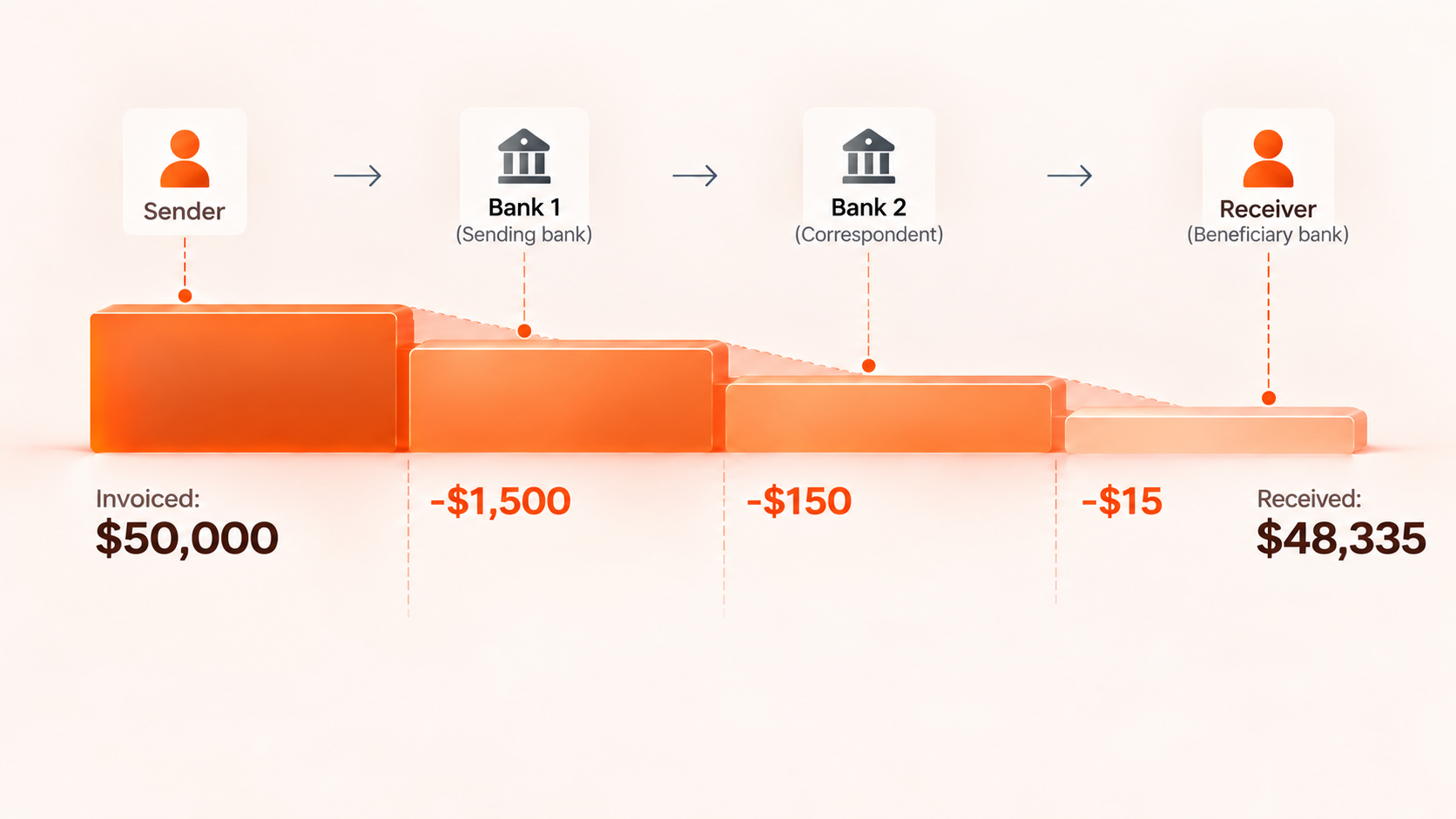
Test 1: $50,000 to a supplier in India
Same amount, same day, same beneficiary. The rail is the only thing that changes.
| Bank wire | Fintech provider | Stablecoin rail |
| Visible fee | Outbound wire fee,$15 to $50 | A stated percentage, disclosed before sending | A stated percentage, disclosed before sending |
| FX treatment | Rate plus an undisclosed markup | Reference rate plus a disclosed fee on major corridors | One quoted rate inclusive of the FX fee |
| In-transit deductions | Intermediary and beneficiary banks can deduct from the proceeds, and the total isn't knowable in advance | None on supported corridors, but falls back to correspondent rails where the corridor isn't supported | None while the value moves on chain |
| Settlement | 2 to 5 business days | Same day to 2 days on major corridors, slower elsewhere | Minutes on chain, then instant across supported corridors and next business day where the local rail clears on a cycle |
| Capital held | 2 to 5 days of the full amount | Typically 1 to 2 days | Minutes to hours |
| Visibility | A reference number, and a bank that won't discuss the other side | A dashboard covering that provider's own leg | One record covering the whole path |
| Corridor coverage | Broad, but thin corridors route through more intermediaries | Strong on major corridors, weaker into the Global South | Deep on supported corridors, absent where a corridor isn't live |
| Audit output | Statement plus manual reconciliation | A provider report, per provider | One ledger and one record per payout |
Run it annually and the comparison starts mattering to a CFO. At 1.6% on $500,000 a month, you're spending $96,000 a year on cross-border cost that appears in no budget line. At 3%, it's $180,000.
Test 2: the same payment where the corridor is thin
Test 1 flatters the bank. A well-served corridor is where correspondent banking performs at its best.
On a thin corridor the bank adds intermediaries. Each one is another deduction point, another screening queue, and another institution that won't answer questions from either end.
The fintech provider often doesn't support the corridor at all, and falls back to the same correspondent rails. So you pay a fintech fee for a bank outcome.
The stablecoin rail either supports the corridor properly or doesn't support it at all. That's a worse answer when it's missing and a much better one when it's there.
Breadth against depth. A bank will move money almost anywhere, badly. A stablecoin rail moves money well on the corridors it has built.
The cost nobody puts on the invoice
Working capital held during settlement is real money, and almost nobody counts it.
$50,000 sitting in transit for 4 days is $50,000 you can't use for inventory, payroll or anything else. The institution holding it during that window earns on the balance. Across a monthly payout run, that compounds into a number worth having.
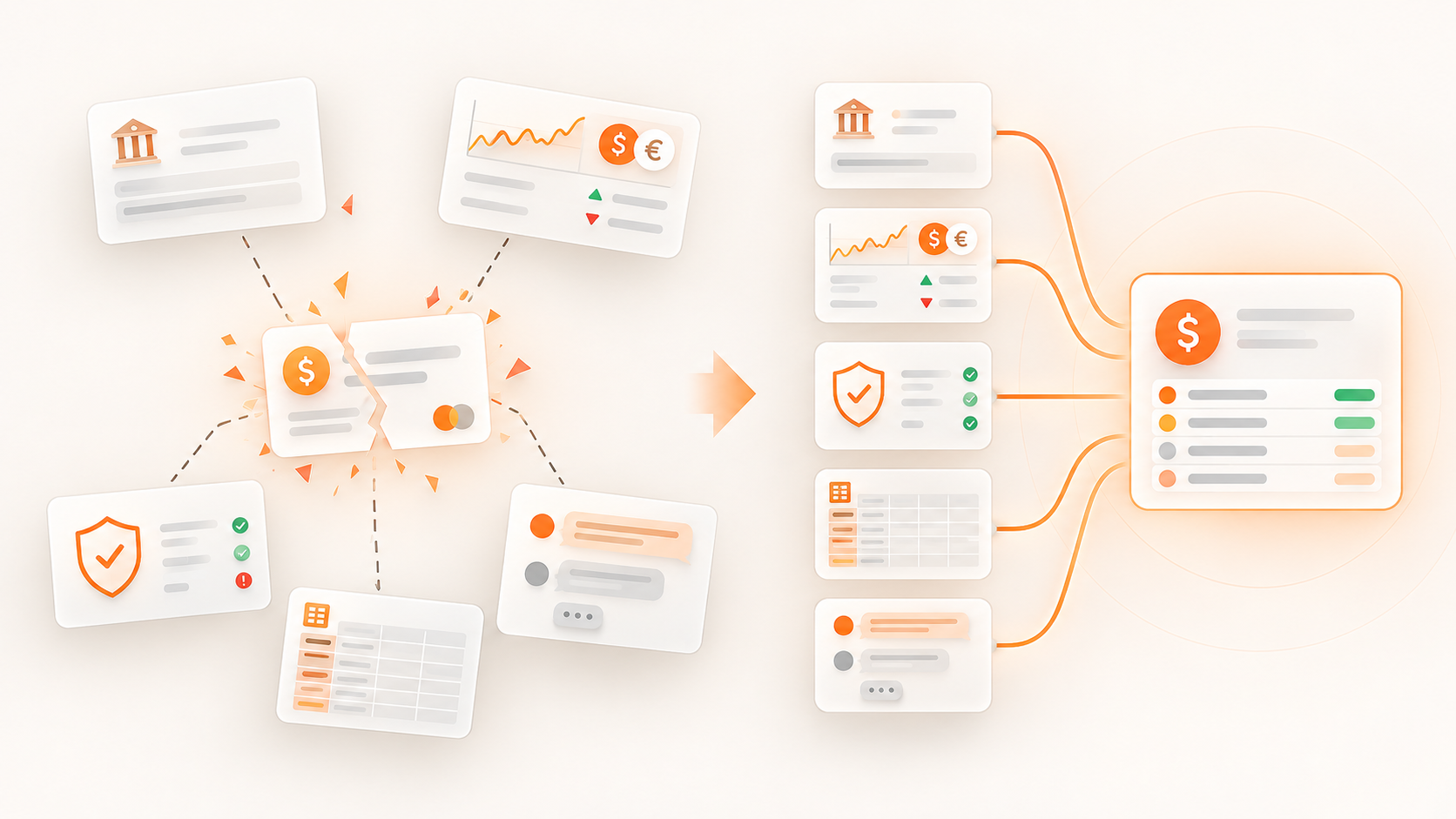
Then add the labour. Reconciling across providers by hand, chasing status, answering a supplier who came up short. All of it is produced by the same architecture.
The cost that ends relationships
The 5th cost never appears in a pricing comparison. It's usually the one that makes a company change rails.
When a payment is in transit and unaccounted for, you're not just waiting. You're making a claim your counterparty can't verify. We sent it on Tuesday sounds, from the other side of the table, exactly like we haven't sent it yet.
Every day it stays invisible, that gap widens. Your supplier starts pricing the relationship differently. Shorter terms. A deposit. Prepayment on the next order. A quiet preference for whoever pays cleanly.
Refunding a fee doesn't fix any of that.
The structural cause is on the record. The G20 roadmap carries a transparency target committing providers to give payers and payees a defined minimum set of information about a payment, and the FSB reported in its 2025 progress report that the available data still isn't enough to measure whether that's happening. The target exists because the disclosure doesn't.
3 questions are worth asking of any rail before the trust cost matters, rather than after.
Can I tell my counterparty the landed amount before I send? If the answer involves an estimate, you've already scheduled the short-payment conversation.
Can I see where the payment is without opening a case? A reference number tells you a payment has started. Visibility means knowing where the money sits at the moment someone asks you.
If it goes wrong, what can I show them? The test is whether you can produce one record covering the whole path, or whether you're assembling evidence from institutions that won't talk to each other.
Where each rail genuinely wins
| Rail | Use it when | Don't use it when |
| Bank wire | The corridor is unusual, the counterparty wants a bank instrument, or your existing banking relationships carry commercial weight | The corridor is thin, the payment is routine, or the beneficiary needs the full invoice amount to arrive |
| Fintech provider | The corridor is major, volumes are moderate, and you want one dashboard | The corridor sits outside their network, or your payouts are large enough that percentage pricing bites |
| Stablecoin rail | Your funds are already in stablecoins, the corridor is supported, and you need to know the landed amount before sending | The corridor isn't live, or the beneficiary can't receive local currency on a regulated regional rail |
Check what your beneficiary would actually receive
Everything above is about a number you can't get until after the money has moved. Here's the version where you get it first.
Pick a corridor, put in an amount, and read the figure under "Recipient Gets". That's what lands in their account.
Try it with the size of your last payout on that corridor. Then compare it against what your beneficiary confirmed receiving. The gap between those 2 numbers is the cost this whole article has been describing.