Intermediary Bank Fees: Who Took the Difference on Your International Payment
Intermediary bank fees are charges that correspondent banks deduct from an international payment while it's in transit, rather than billing you afterwards. They come out of the money itself, so your beneficiary gets less than the invoice amount while your statement still shows the full sum leaving. No bank in the chain will tell you which one took the difference, and none of them has to.
What is an intermediary bank, and why is one involved at all
Your bank and your beneficiary's bank probably don't have an account with each other. Most banks don't.
So the payment gets routed through a third bank that holds accounts with both. That's the intermediary, sometimes called a correspondent. On thin corridors there can be 2 or 3 of them in a row.
Each one is a separate company. Each one charges for its part.
Why does the beneficiary get less than you sent?
Because the charge comes out of the payment, not out of your account.
A fee billed to you shows up on a statement, in a currency you recognize, on a date you can reconcile. A fee taken in transit shows up nowhere you can see. Your records say $50,000 left. Their records say something smaller arrived. Neither set of records contains the event in between.
Banks say this in their own paperwork, and have said it for a decade. Capital One's international wire guide for treasury clients calls these charges beneficiary deduction fees, and gives the reason nobody can quote them upfront: not every intermediary is known when the wire starts, so the sum of all fees cannot be determined until after the wire transfer has been completed. That guidance has been in force since 2016 and the position hasn't moved.
Your bank tells you in writing, before you send, that the cost of sending can't be known until the money has already gone.
What do OUR, BEN and SHA actually mean?
Every international payment carries a charge code deciding who absorbs the fees down the chain. Most finance teams have never heard of them, which is odd, because they decide whether an invoice gets paid in full.
| Code | Who pays | What the beneficiary gets | Where it goes wrong |
| OUR | You pay everything, including intermediary and beneficiary bank fees | The full invoice amount, in principle | You get billed the intermediary charges weeks later, and you can't know the amount in advance |
| BEN | The beneficiary absorbs every charge | The invoice amount minus every deduction in transit | They're short paid and dispute an invoice you consider settled in full |
| SHA | You pay your own bank, the beneficiary absorbs the rest | The invoice amount minus intermediary and receiving bank charges | The usual default, and the usual cause of an unexplained shortfall |
SHA is the common default. So the standard behavior of an international payment, absent any instruction from you, is that your beneficiary gets less than you sent and nobody tells either of you how much less until it lands.
One practical note before you call your bank. Swift retired the MT103 format for cross-border payments in November 2025. These codes now travel under different names: DEBT for OUR, CRED for BEN, SHAR for SHA. The Federal Reserve tells its wire participants to default to SHAR unless another code applies. Ask for the charge bearer code on a specific payment and you'll get an answer faster using the term their systems actually run on.
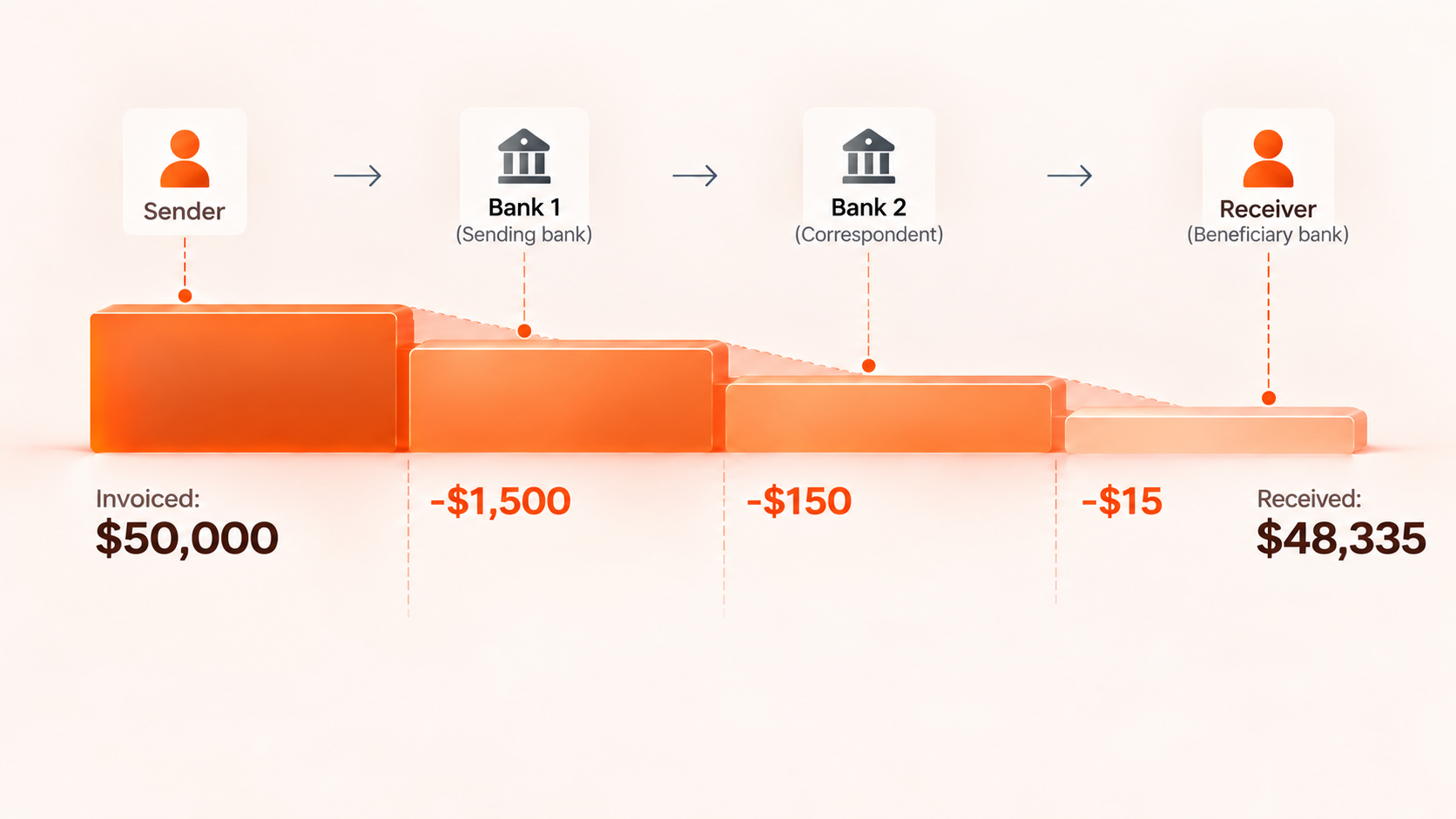
How much does a $50,000 payment lose in transit?
Say you're paying $50,000 to a beneficiary who needs it in local currency. 4 charges are in play. Only 2 of them are published anywhere.
Published, you pay it. Bank of America's business schedule of fees effective 20 February 2026 sets an international outgoing wire in USD at $45. The same schedule charges no wire fee at all when you send in foreign currency, which is your first clue about where the money actually is.
Published, the beneficiary pays it. The receiving bank takes an incoming fee out of the arriving funds. Bank of America charges $15. Dime Bank's schedule of charges effective 3 February 2026 lists $10.
Published by nobody: the correspondent deduction. Every intermediary takes a handling charge out of the principal before passing it on. No bank publishes it, because it isn't their charge to publish. The Australian competition regulator describes the same mechanism in its 2024 review of international money transfers: a correspondent charges a fee, and that fee comes out of the amount sent. Reported figures run $15 to $50 per intermediary, across 1 to 3 of them.
Published by nobody, and bigger than everything above: the rate. Bank of America states in that same schedule that markups are built into its exchange rate, that it makes money from the currency conversion, and that rates are set by the bank at its sole discretion.
The arithmetic
| Line | Amount |
| Payment instructed | $50,000 |
| Your outgoing wire fee, charged separately | $0 to $45 |
| Correspondent deductions in transit, 1 to 3 hops | −$15 to −$150 |
| Receiving bank incoming fee | −$10 to −$15 |
| Cost carried inside the exchange rate | −$800 to −$1,500 |
| Total cost of the payment | $825 to $1,710 |
| Share of the payment | up to 3.42% |
Those rate figures aren't guesses. The FSB's 2024 survey of payment providers found B2B costs for small and medium firms averaged 1.6%, against a G20 target of 1% by the end of 2027, with other payment types above 2%. On $50,000, the measured average is $800. The corridors missing the 3% ceiling reach $1,500.
Look at the shape of that table. The one line you can price exactly is the smallest one in it.
The wire fee was always the least interesting number here. Banks charge $15 to $50 per SWIFT transaction. Now put that against the flow: about $145 trillion of wholesale business payments cross borders every year, and Polygon Labs pointed out in March 2026 that a take rate of just 0.1% on that is roughly $145 billion a year.
And the gap isn't closing. The FSB's 2025 progress report found costs have improved only slightly since 2023, called the global average sticky, and said hitting the 2027 deadline now looks unlikely. On the transparency target it went further, and said the available data still isn't enough to form a complete picture.
So the body responsible for measuring disclosure in cross-border payments can't fully measure it, because the disclosures aren't being made.
Is the correspondent route getting worse?
It isn't a static problem that competition is quietly fixing. 3 measured trends run the other way.
The network is shrinking. The BIS has tracked active correspondent banking relationships since 2011 using Swift message data. They contracted by about 25% between 2011 and 2020 while volumes kept rising. BIS analysis puts compliance risk as the main driver, and finds the retreat steepest in the emerging markets where your beneficiaries sit. Fewer direct relationships, more hops. Every hop is another deduction point.
The banks are the expensive option, on a regulator's own numbers. The ACCC looked at the international transfer market 5 years after its 2019 inquiry. On transfers of A$10,000, it found the big 4 banks were the 4 most expensive suppliers in the market over the period examined. That's a competition regulator, using supplier data, putting the incumbents last on price.
The format they ran on is retired. Swift withdrew MT103 for cross-border payments in November 2025. Its replacement, pacs.008, carries a charges block built to record what each agent deducted. So the industry has built the field. What it hasn't built is any obligation to show you what's in it.
The ACCC's own consumer guidance tells people to ask their provider directly whether correspondent banks will deduct fees from the funds, and warns that a supplier advertising itself as fee-free might still be charging a margin inside the rate. When a regulator's advice is to interrogate your own bank before sending, this stops being a matter of opinion.
Why won't anyone tell you which bank took the money?
It's contractual, not technical. The correspondent has no contract with you and owes you no disclosure. Its relationship runs to the bank that handed it the payment.
You can see this in how disputes get resolved. When a payment arrives short, the UK Financial Ombudsman Service doesn't ask you what happened. It asks the payment business to produce the payment message and the details of any correspondent banks involved, and expects that business to have warned you in advance that a correspondent might take fees straight from the payment.
A formal dispute body has to rebuild the chain from the underlying message, because rebuilding it is the only way anyone finds out.
Where regulators have fixed this, they drew a narrow boundary around the fix. European rules bar deductions from the transferred amount when both banks sit inside the Union, and stop applying the moment the receiving bank sits outside it. US disclosure rules require the provider to state what the recipient will get, and they reach transfers sent by consumers. Send $500 to a relative abroad and you're covered. Settle a $50,000 invoice through the same chain and you're not.
What can a finance team actually do about it?
4 things, in descending order of usefulness.
Set the charge code on purpose. If beneficiaries keep coming up short, SHA is probably why. Sending under OUR moves the cost onto you, which at least makes it visible and forecastable.
Reconcile against what arrived, never what you sent. A payment that leaves at invoice value and lands below it reconciles cleanly on your side and opens a dispute on theirs. You'll hear about it weeks later, as a relationship problem.
Count the hops. Ask your bank how many correspondents a given corridor routes through. More hops, more deduction points, more delay. The answer varies wildly between corridors that look identical on paper.
Check the quoted rate against mid-market on the day. The spread is usually bigger than every explicit fee combined, and it's the least documented cost in the chain. Our guide to what an FX spread costs your business annually shows how to work it out on your own corridor.
All 4 manage the problem. None of them removes it, because the chain still contains parties who owe you nothing.
Worth holding next to that table: stablecoin payout rails price the same payment as a single figure quoted before the money moves. On $50,000 that's mostly less than 80% of what you pay through traditional rails, with no correspondent chain in the middle to deduct from it. Whether it suits a given corridor is a separate question. The narrow point is that it's a number you can know in advance, which is the one thing the correspondent model can't offer.
You can budget for a fixed fee. You can't budget for a routing decision made after the money leaves. The only reliable way to answer who took the difference is to run a chain short enough that everyone in it can be named before the money moves.
Measure it before you try to fix it
Pull the 3 largest international payments you made last quarter. Put the amount you instructed next to the amount your beneficiary was credited.
If those numbers differ, ask your bank 2 questions: what charge bearer code went on the payment, and which correspondents handled it. You're entitled to the answer on your own transaction, and how fast it arrives tells you something by itself.
Then go after the bigger number. Correspondent deductions cost you $15 to $150 on a $50,000 payment. The rate costs you $800 to $1,500 on the same payment, and it's the one you can actually renegotiate.
Our guide to what an FX spread costs your business annually walks through the per-corridor calculation, the annualized figure, and where the arithmetic changes if you pay from a stable coin balance.
Frequently asked questions
What are intermediary bank fees?
Charges taken by banks sitting between the sending and receiving bank on an international payment. They come out of the payment as it moves, which is why the beneficiary can get less than you sent.
Can intermediary bank fees be avoided?
Not inside the correspondent banking model, though sending under the OUR charge code moves them onto you instead of the beneficiary. Avoiding them entirely takes a payout route that doesn't pass through a correspondent chain.
Why can my bank not tell me who deducted the fee?
Once a payment leaves the originating bank it passes through institutions that have no relationship with you. Your bank can't itemise what it doesn't know either, because the full routing isn't fixed when the wire starts.
What replaced OUR, BEN and SHA?
The codes still exist under different names. Swift retired MT103 for cross-border payments in November 2025, and the charge bearer field now carries DEBT, CRED and SHAR. Use those terms when you query a specific payment.
RELATED READS
Zoth Expands zPayments on Base with Instant Payouts Across 171 Countries, Targets $6B in Annual Volume

The true cost of one payout: bank wire vs fintech vs stablecoin rails