What is FX Spread, and What it Costs Your Business Annually?
TL;DR
- An FX spread is the gap between the mid-market rate and the rate your provider actually applies. It is not a fee, it is a worse rate, which is why it never shows up as a line item.
- Banks typically charge 2 to 4 percent on business payments. Payment providers run 0.5 to 3 percent. On a $50,000 monthly payout book, a 2.5 percent spread costs $15,000 a year.
- You cannot calculate your spread from a bank statement alone. You need the mid-market rate at the moment your payment is executed, and that timestamp is gone by the time you reconcile.
- The spread is only one of four costs. Wire fees, intermediary deductions and beneficiary charges sit alongside it, and the intermediary deduction is the one neither you nor your recipient can see.
- Ask your provider one question: what rate did you apply, and at what time. A provider who will not answer precisely is telling you something.
- zFX calculates your spread against the live mid-market rate and shows what it costs across twelve months. Free, no signup.
You pay an agency in Bangalore $18,000. Your bank charges a $25 wire fee, which you log and forget about.
What the statement never shows is that the rate applied was 2.4 percent worse than the mid-market rate that morning. That is $432 on one payment, seventeen times the wire fee you actually noticed.
Do that twice a month and you have spent $10,368 a year on something that appears nowhere in your accounts as a cost.
This is what an FX spread is, how to work out what yours is costing, and what else gets taken alongside it.
What is an FX spread?
An FX spread is the difference between the mid-market exchange rate and the rate your bank or payment provider applies to your transaction.
It is not a fee. That distinction matters more than it sounds. A fee is charged, recorded and disclosed. A spread is a worse exchange rate, so it never appears as a line item anywhere. Your money simply converts at a number lower than the market number, and the difference stays with whoever converted it.
The mid-market rate, sometimes called the interbank rate, is the midpoint between the buy and sell prices for a currency pair on the global market at a given moment. It is the rate you see on Google, Reuters or XE. It is a reference rate, not a rate anyone gives you, which is why every provider applies some margin over it. The question is never whether there is a spread. It is how wide it is and whether you were told.
FX markup means the same thing. Providers use "markup" when describing what they add and "spread" when describing what you lose. Both refer to the same gap.
How does an FX spread work?
Take a single payment and follow the number.
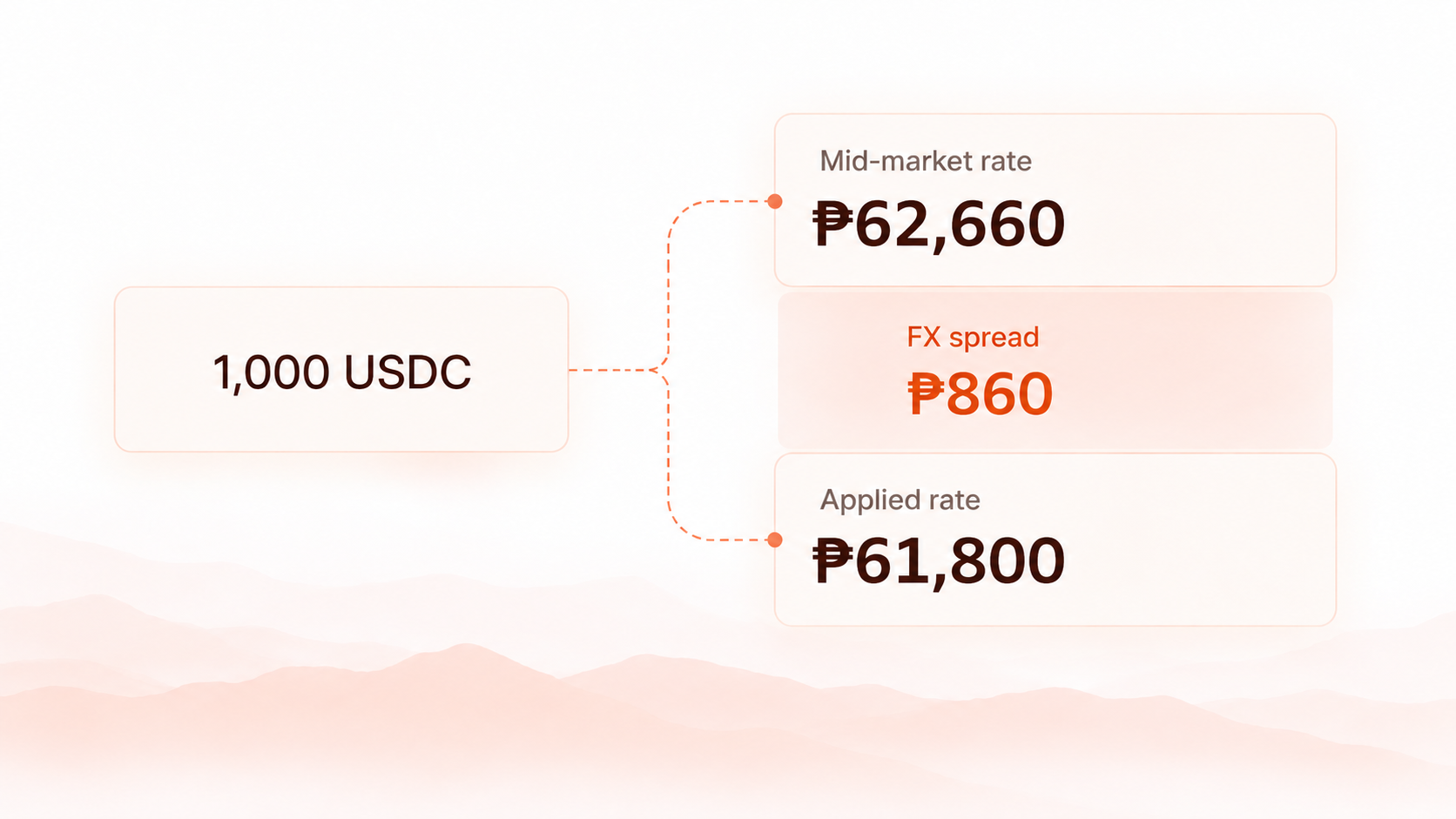
The mid-market USD to PHP rate is 58.40. Your bank quotes you 57.00. You send $18,000.
| Source | Rate applied | Recipient gets |
|---|---|---|
| Mid-market | 58.40 | ₱1,051,200 |
| Your bank | 57.00 | ₱1,026,000 |
| Difference | 1.40 | ₱25,200 |
The spread as a percentage is the gap divided by the mid-market rate. Here that is 1.40 divided by 58.40, which is 2.4 percent, or 240 basis points.
Two things about that calculation are worth noticing.
The percentage is what travels between currencies. A 1.40 gap means nothing on its own. On USD to PHP it is 2.4 percent. On USD to JPY, where the rate sits near 150, a 1.40 gap would be under 1 percent. Always convert to a percentage before comparing anything.
Your effective rate is the only number that matters. Take what your recipient actually received, divide by what you sent, and you have the rate you truly got, inclusive of every deduction. In the example above, if ₱1,026,000 arrived and you sent $18,000, your effective rate is 57.00. If ₱1,020,000 arrived because an intermediary bank took a cut, your effective rate is 56.67, and your real cost was higher than the spread alone.
Why you cannot see the FX spread on your statement
Every article on this subject tells you to compare your rate against the mid-market rate. Almost none of them mention that you usually cannot.
Here is why. The mid-market rate moves continuously. To measure your spread you need the mid-market rate at the moment your payment is converted, not this morning's rate and not the daily close. Your bank statement does not carry that timestamp. Neither does your remittance advice or your accounting software. By the time your team reconciles at month end, the number you would need to compare against no longer exists in any record you hold.
This is the real reason finance teams do not know their FX cost. It is not carelessness. The data required to calculate it is deliberately absent from the paperwork.
Three other things keep it hidden.
No line item exists. A wire fee appears on a statement. A spread does not, because nothing was charged. There is nothing for your accounting system to categorise, so it never becomes a cost centre anyone owns.
The variance looks like rounding. A 2 percent gap on a mid-size invoice often reads as an unremarkable difference between expected and actual. It gets written off in reconciliation, and the same amount leaks the following month.
Different providers hide it differently. Some quote "no transfer fee" and take everything in the rate. Some charge a visible fee and a spread. Comparing two providers on their advertised fee tells you almost nothing about which one is cheaper.
How to calculate your FX spread
You can reconstruct this from records you already have. It takes about twenty minutes for a quarter of payments.
Step 1. Pull your last ten international payments. For each one, record the date and time you instructed it, the amount sent in your currency, and the amount your recipient confirmed receiving in theirs.
Step 2. Get the mid-market rate for each of those timestamps. Historical rate data is freely available from XE, OANDA and Google Finance. Use the rate closest to the time of execution. If you only have the date, use the daily average and accept a small margin of error.
Step 3. Calculate your effective rate. Divide the amount received by the amount sent. This is the rate you actually got, after everything.
Step 4. Calculate the gap. Subtract your effective rate from the mid-market rate, then divide by the mid-market rate. Multiply by 100. That is your spread as a percentage.
Step 5. Take the average across all ten. One payment tells you little. Ten tells you your blended cost.
Step 6. Do it per corridor. This is the step most businesses skip, and it is where the useful finding usually is. If you pay into India, the Philippines and the UAE, you have three different spreads and one blended figure. The blended number is what you budget with. The per-corridor numbers are what you renegotiate with.
Two shortcuts worth knowing. Ask your provider directly: "What rate did you apply to this payment, and at what time?" A provider who quotes a specific rate and timestamp is one you can measure. A provider who deflects is telling you the answer is uncomfortable. And where your recipient is in India, their bank issues a Foreign Inward Remittance Advice showing the rate applied, which is a clean record you can work from.
Or skip the arithmetic. zFX takes your amount, your currency pair and the rate you were quoted, compares it against the live mid-market rate, and returns your spread as a percentage, the cost on that payment, and the annualised figure. It runs without a signup.
What an FX spread costs your business annually
The single-payment number never changes anyone's mind. The annual number usually does.
The arithmetic is straightforward: monthly payout volume × spread percentage × 12.
| Monthly volume | 1% spread | 2.5% spread | 4% spread |
| $25,000 | $3,000 | $7,500 | $12,000 |
| $50,000 | $6,000 | $15,000 | $24,000 |
| $100,000 | $12,000 | $30,000 | $48,000 |
| $250,000 | $30,000 | $75,000 | $120,000 |
| $500,000 | $60,000 | $150,000 | $240,000 |
Run it against a real business. A development agency in Berlin pays forty contractors across India and the Philippines, roughly $85,000 a month. Their bank applies an average 2.8 percent spread. That is $2,380 a month and $28,560 a year, none of which appears on a P&L as an FX cost. It shows up instead as slightly higher contractor costs, spread across twelve months and forty payees, where nobody attributes it to anything.
For context on scale, Wise research put the amount US small and medium businesses lost to opaque foreign exchange fees at roughly $800 million in 2023.
The reason this number moves decisions is that it converts a rounding error into a budget line. Half a percent on one invoice is immaterial. Half a percent on an annual payout book is a hire.
What else gets taken beyond the FX spread
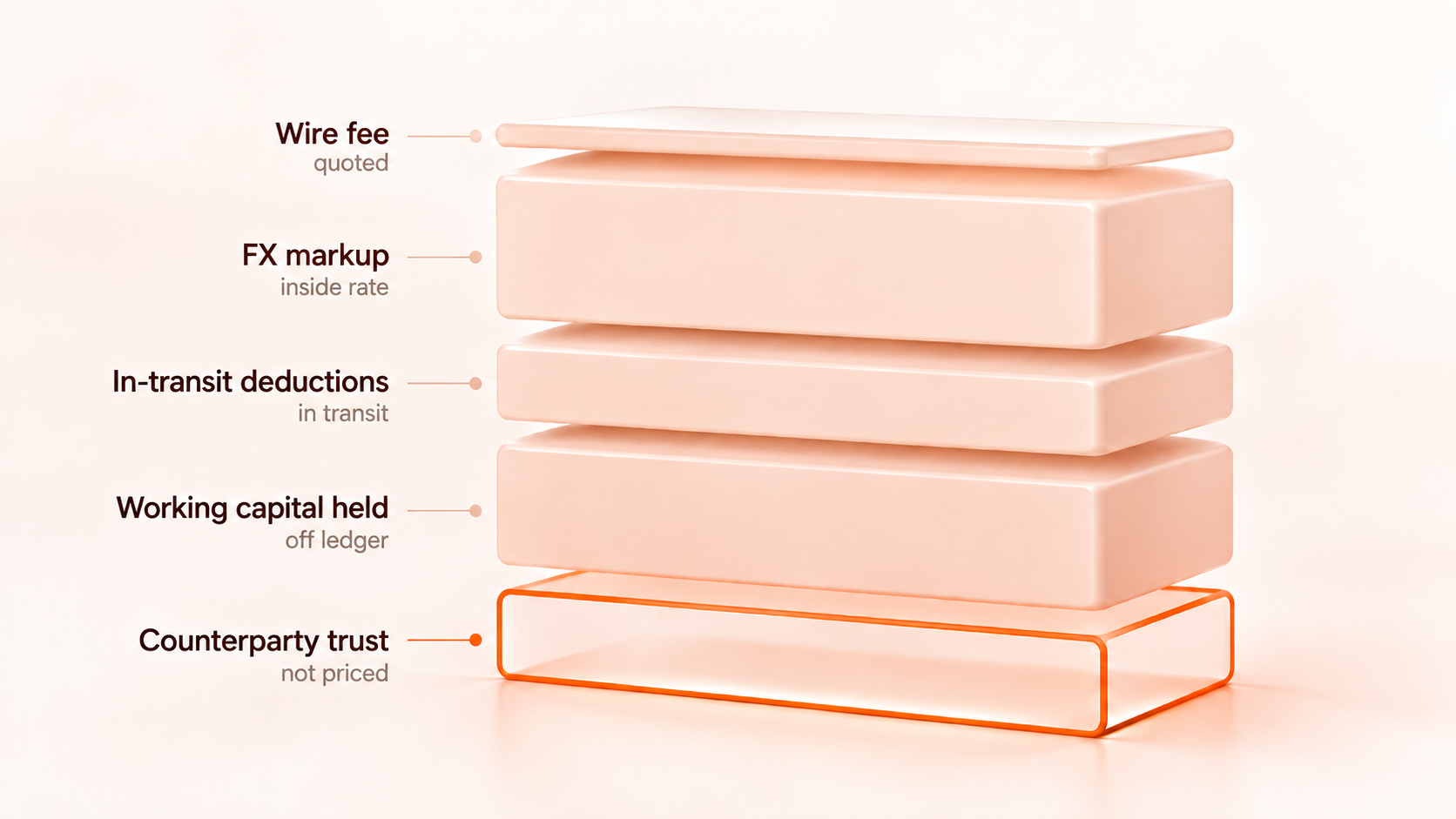
The spread is the largest cost on most international payments, but it is one of four. Businesses that only measure the spread underestimate their total leakage.
The wire fee. Your bank charges $15 to $50 to send. Visible, disclosed, and usually the only cost anyone notices. At ten payments a month that is $1,800 to $6,000 a year.
Intermediary or lifting fees. This is the invisible one. A wire routed through the correspondent banking network typically passes through one to three intermediary banks, and each can deduct a fee from the principal as it passes. Nobody tells you, and nobody tells your recipient. You find out because the amount that arrived is smaller than the amount you sent, and neither side can explain the gap. Which party absorbs these is set by a charge code on the instruction.
The beneficiary bank charge. Your recipient's own bank may deduct an inward payment fee on receipt. It sits outside your spread and outside your control, and your recipient absorbs it silently.
Rate movement between quote and execution. Where a provider quotes a rate but does not hold it, the rate that lands is the rate at execution, not the rate you agreed. On a volatile pair over a two-day settlement window, this can exceed the spread itself. Ask any provider how long a quote is held. "Indicative" means it is not held.
Add them together and a payment advertised as costing $25 in fees can realistically cost 3 to 6 percent of value. That is why our own FX spread calculator asks for the amount your recipient confirmed receiving, not the amount your provider said they sent.
What makes one FX spread wider than another?
Spreads are not a fixed property of a provider. The same bank will quote you very differently depending on four variables.
The currency pair. Major pairs such as EUR to USD or GBP to USD trade in enormous volume and carry the thinnest spreads. Pairs involving Global South currencies, thinner markets or restricted currencies carry materially wider ones. A provider advertising a low spread is almost always advertising their best pair.
The amount. Larger transactions usually attract tighter percentage spreads, because the provider's fixed cost is spread across more value. This cuts both ways: many small payments will cost you more in percentage terms than the same total sent as one payment.
Timing. Spreads widen outside the trading hours of the relevant currencies, over weekends, and around major economic announcements. A Friday evening payment into an Asian currency is a worse trade than the same payment on Tuesday morning.
Whether the quote is held. A rate locked at the moment you agree it is a different product from a rate applied at some point after you instruct. The second is not really a quote.
Your relationship and volume. Bank spreads are negotiable, particularly above meaningful volume. Most businesses never ask. The ones that do frequently find the published rate was not the only rate available.
How much do banks and payment providers actually charge?
Published ranges, as at 2026. Treat these as bands rather than fixed prices, because every variable above moves them.
| Provider | Typical FX spread | Notes |
| Commercial and correspondent banks | 2% to 5% | Embedded in the exchange rate, plus a separate wire fee and any intermediary deductions |
| PayPal | 3% to 4% | A disclosed conversion spread above PayPal's base rate, stacked on a processing fee that reaches around 4.4% on international transactions |
| Card networks | 2% to 3.5% | Two separate charges. The network converts at close to mid-market, then the issuing bank adds a foreign transaction fee |
| Money transfer operators | 1% to 3% | Fee plus exchange rate margin combined, per the World Bank International MTO Index |
| Wise | Around 0.5% to 1.5% | No spread. Conversion happens at the mid-market rate and the fee is charged visibly upfront |
| Stablecoin settlement platforms | Varies by corridor | Conversion happens once rather than at each hop, so intermediary deductions do not arise |
Figures as at 2026. World Bank Remittance Prices Worldwide measures consumer-sized transfers and includes both fee and exchange rate margin, so business FX spreads on larger tickets typically run lower than the headline averages.
Note: On a card payment there are two separate charges, not one. The network, Visa or Mastercard, converts at close to the mid-market rate. Your issuing bank then adds a foreign transaction fee on top. Mastercard's own currency converter makes this visible by asking you to enter your bank fee separately, because the network does not know what your bank charges.
Three caveats. "Zero markup" usually means zero on the conversion, with revenue taken as a flat fee instead, which is cheaper or more expensive than a spread depending on your ticket size. A low headline spread is almost always quoted on a major pair and tells you nothing about the corridor you pay into. And ranges move, so treat these as bands rather than prices and verify against a current quote.
How to reduce what you lose to FX
Six things, roughly in order of impact.
Measure it first. You cannot negotiate a number you do not have. Run the calculation above, or run it through zFX, and get a per-corridor figure before you talk to anyone.
Compare the amount received, not the fee. The only honest comparison between two providers is how much money reached your recipient from the same amount sent on the same day.
Insist on a held quote. Ask how long a quoted rate is held and what happens if execution falls outside that window. An indicative rate transfers the risk to you.
Consolidate payments. Five payments of $2,000 attract five fixed fees. One payment of $10,000 attracts one, and usually a tighter spread.
Cut out the correspondent chain. Intermediary deductions exist because the payment hops between banks. Rails that deliver into local payment systems directly do not have those hops, which removes the one cost you cannot otherwise see.
Negotiate. Above meaningful monthly volume, spreads are a commercial term rather than a published price.
Where stablecoin rails change the arithmetic
Most of the cost above comes from the structure of correspondent banking rather than from anyone's pricing decision. Each hop in the chain converts, deducts or delays, and the spread compounds along the way.
Settling on stablecoin rails removes the chain. Value moves once, converts once at a rate agreed before the payment is sent, and is delivered into the recipient's local payment system. There is no intermediary bank to take a lifting fee, because there is no intermediary bank.
zPayments pays contractors, vendors and suppliers in local currency from a stablecoin balance, across 171 countries. You see one stated rate before the payment is sent, and it does not change when it lands. Settlement is instant across supported corridors, and next business day where a local rail clears on a cycle. Screening, Travel Rule checks and monitoring run inside the platform. Zoth is registered as a Money Services Business with FINTRAC, and payouts settle through licensed partners regulated in each corridor.
Before you talk to us or to anyone else, work out what you are paying now. ++Run your numbers through zFX++ and bring the figure to the conversation.
Frequently asked questions
What is an FX spread?
An FX spread is the difference between the mid-market exchange rate and the rate your provider applies to your payment. It is taken inside the rate rather than charged as a fee, which is why it does not appear on your statement.
What is the difference between an FX spread and an FX markup?
They describe the same gap from opposite sides. Providers say markup when describing what they add to the mid-market rate. You experience it as a spread, meaning a worse rate than the market rate.
What is the mid-market rate?
The midpoint between the buy and sell price of a currency pair on the global market at a given moment. It is the reference rate used to measure a spread, and it is not a rate available to end users, which is why every provider applies some margin to it.
How do I calculate my FX spread?
Divide the amount your recipient received by the amount you sent to get your effective rate. Compare that against the mid-market rate at the time you executed, subtract, divide by the mid-market rate and multiply by 100. Or enter your figures into zFX.
What is a reasonable FX spread for a business?
Banks typically apply 2 to 4 percent on business payments, digital platforms 0.5 to 2 percent, and stablecoin settlement platforms under 1 percent. Thin corridors carry wider spreads than major currency pairs, so compare within your own corridor rather than against a global average.
Does an FX spread include wire fees?
No. A wire fee is a separate charge, usually $15 to $50. The spread sits inside the exchange rate. Intermediary bank deductions and beneficiary bank charges are also separate and are not captured in the spread.
Can I negotiate the FX spread with my bank?
Often, yes, particularly above meaningful monthly volume. Spreads are a commercial term rather than a fixed price, and most businesses never ask.
Why does my recipient receive less than I sent?
Usually intermediary banks. A wire routed through the correspondent network can pass through one to three banks, each of which may deduct a fee from the principal without notifying either party. Your recipient's own bank may also apply an inward payment charge.
RELATED READS
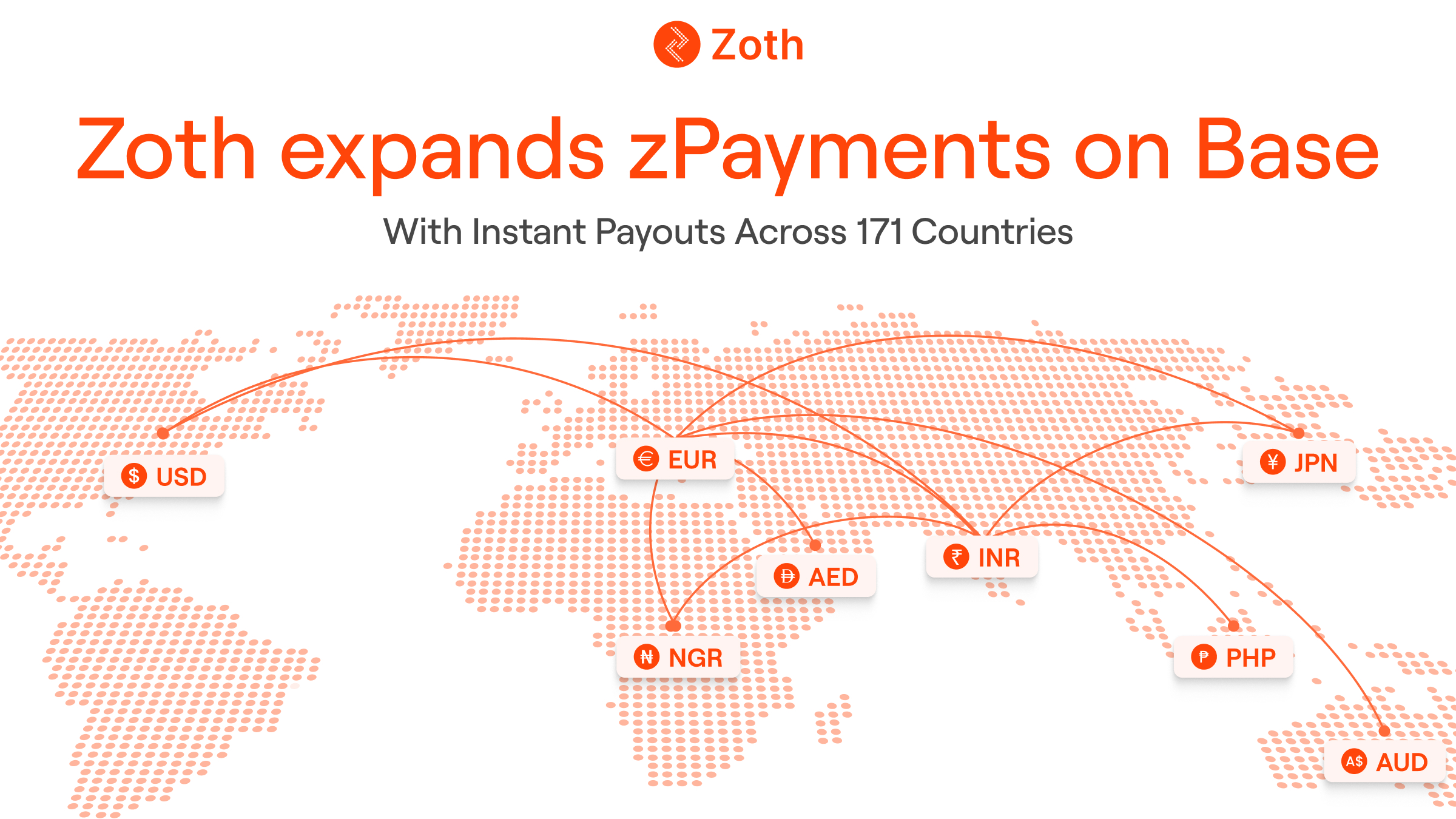
Zoth Expands zPayments on Base with Instant Payouts Across 171 Countries, Targets $6B in Annual Volume
The true cost of one payout: bank wire vs fintech vs stablecoin rails