Yes, in most major markets, and the qualifier is doing real work. A stablecoin payment is compliant when three separate tests pass at once, in three different places, under three different regulators. Most providers can prove one of them.
Paying a supplier, contractor or employee with a stablecoin is lawful in most major economies today, provided the token is issued under a recognized regime, the provider holds the registration or license its home regulator requires, and the payment is permitted and properly reported in the country where it lands. Those are separate tests. Passing the first does not carry the other two.
Key takeaways
- Legality and compliance are different questions. Stablecoin payments are legal in most major markets. Whether a specific payment is compliant depends on the provider, the corridor and the reporting that follows it.
- Regulation of the token is now settled in the largest markets. The United States passed the GENIUS Act in July 2025. The European Union has applied its e-money token rules since June 2024. Neither governs whether you may pay a vendor abroad.
- Every region applies its own checks. The United Arab Emirates restricts which tokens may be used for payment at all. Singapore has a framework announced in 2023 that is still being written into law. The Philippines requires licensed providers to deal only with other licensed providers.
- One rule is close to universal. The travel rule, FATF Recommendation 16, requires originator and beneficiary information to accompany a payment. The FATF reported in July 2026 that 83 per cent of surveyed jurisdictions have passed legislation implementing it.
- Compliance usually fails at the destination, not at the token. Ask your provider for a registration number you can verify yourself and for the name of the institution that credits local currency. On zPayments, both come with the corridor rather than after the contract.
The three tests a compliant stablecoin payment has to pass
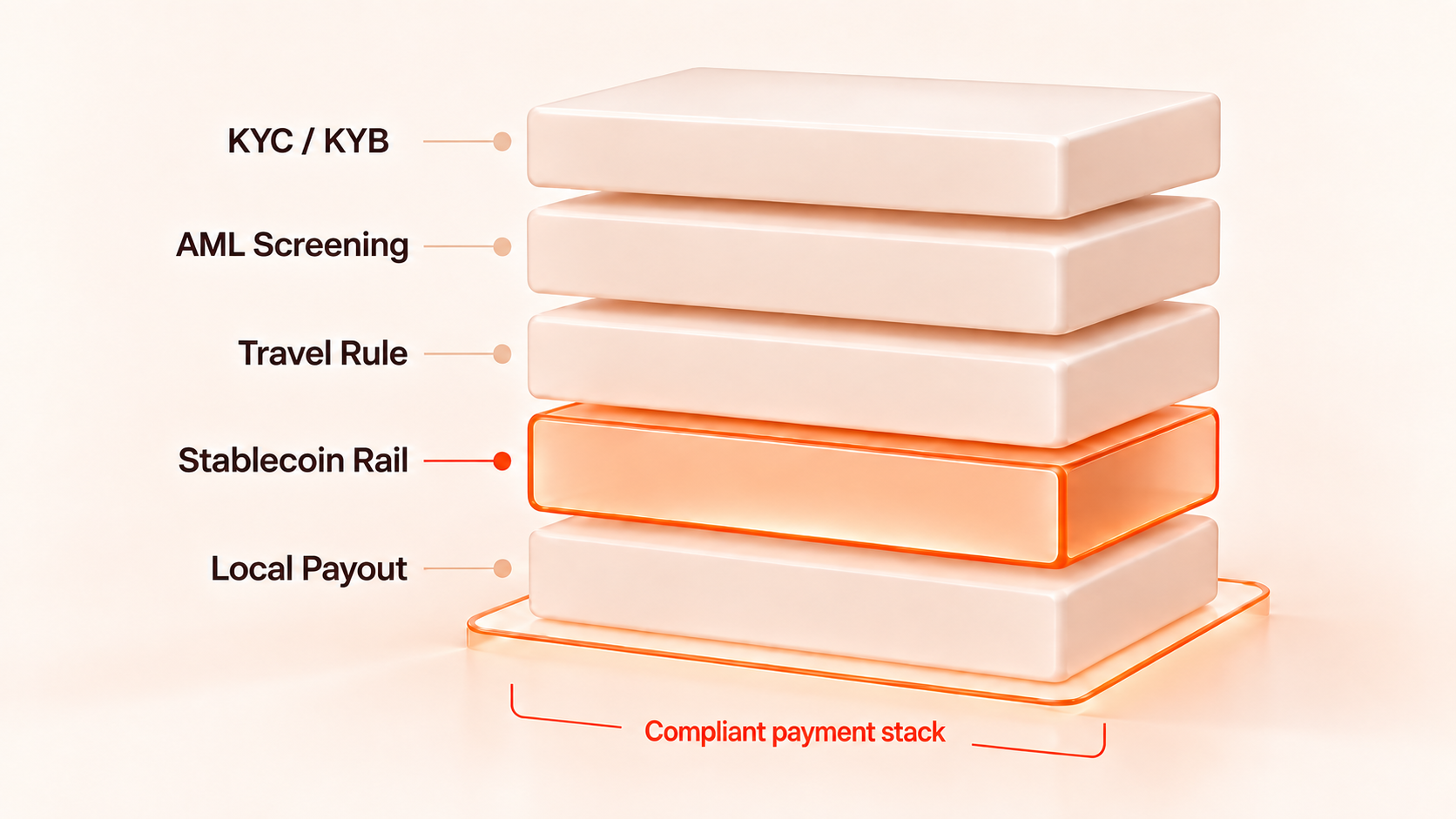
A stablecoin payment is a chain, and it is compliant only if no link is broken. Three tests decide it.
Test one, the token. Is the stablecoin issued by an entity authorized to issue it, with reserves held and redeemable under a recognized regime? In the largest markets this now has a clear answer. The GENIUS Act was enacted on 18 July 2025 as Public Law 119-27 and creates the first federal framework for payment stablecoins in the United States. Its central prohibition, at 12 U.S.C. § 5902, takes effect on the earlier of eighteen months after enactment or 120 days after the primary federal regulators issue final implementing rules. In the European Union, Regulation (EU) 2023/1114, known as MiCA, has applied its e-money token rules since 30 June 2024, with the remainder of the regulation applying from 30 December 2024.
Test two, the provider. Is the business moving your money registered or licensed to do so, and supervised against that registration? This is a question about the platform, not the token, and it is answered by the provider's home regulator.
Test three, the payment. Is this payment, to this beneficiary, for this purpose, permitted in the destination country, and does it produce the record that country requires? This test is answered locally, and it is the one that fails.
Most published guidance on this subject answers test one at length and stops. That is why a company can fund a payment with a fully regulated token, send it through a registered platform, and still end up with a payment its counterparty cannot account for.
The legality of paying from stablecoin rails
In most major markets, yes. Very few jurisdictions prohibit a business from settling an obligation using a regulated stablecoin through a licensed intermediary. What jurisdictions do instead is condition it.
Three kinds of condition are common, and they are worth telling apart because they fail in different ways.
Conditions on the token. Some markets restrict which tokens may be used for payment at all, regardless of who is sending them. The United Arab Emirates is the clearest example, covered below.
Conditions on the intermediary. Most markets require whoever handles the money to hold a specific authorization, and some require that every counterparty in the chain hold one too.
Conditions on the record. Almost every market requires the payment to be reported, either to a financial intelligence unit, a central bank reporting system, or both. A payment that moves correctly but is never recorded creates a problem months later, usually for the person who received it.
Legality is rarely the obstacle. The obstacle is meeting all three conditions in a country you do not operate in, using a provider you have not verified.
Three layers of regulation, three different regulators
Three layers, three regulators, three distinct failure modes.
| Layer |
What is regulated |
Who regulates it |
What fails when it breaks |
| The token |
Reserves, redemption, issuer authorization, permitted use |
Federal regulators under the GENIUS Act, the EBA and national authorities under MiCA, central banks elsewhere |
The token is delisted or barred from use in that market. Your funding leg stops working |
| The provider |
Registration, customer due diligence, sanctions screening, travel rule, monitoring |
The provider's home regulator, such as FINTRAC in Canada or the BSP in the Philippines |
Accounts freeze, banking partners withdraw, payments stop mid-run |
| The payment |
Whether the payment is permitted, to whom, for what purpose, and how it is reported |
The destination country's central bank, financial intelligence unit and tax authority |
The money lands and creates a problem. No reporting entry, no certificate, no closure |
Due diligence usually covers the first layer, sometimes the second, and almost never the third.
Why every region applies its own compliance checks
Because a payment touches two monetary systems, and each one protects its own. A central bank has no interest in how a token is regulated three jurisdictions away. It cares whether foreign currency entered or left its economy, who sent it, who received it, and whether that is recorded where it can be audited.
The result is that the same payment, from the same sender, using the same token, is subject to materially different rules depending on where it lands.
| Market |
Framework |
What it actually constrains |
| United States |
GENIUS Act, Public Law 119-27, enacted 18 July 2025 |
Who may issue a payment stablecoin, with reserve and redemption requirements. Money transmission remains separately licensed at state and federal level |
| European Union |
MiCA, Regulation (EU) 2023/1114, plus the Transfer of Funds Regulation, Regulation (EU) 2023/1113 |
Issuer authorization for e-money tokens, and a hard requirement from 30 December 2024 that originator and beneficiary information accompany crypto-asset transfers |
| United Arab Emirates |
CBUAE Payment Token Services Regulation, Circular No. 2/2024, issued June 2024 |
Which tokens may be used to pay for goods and services at all. Payment generally requires a Dirham Payment Token from a CBUAE-licensed issuer. Financial free zones including DIFC and ADGM sit outside it |
| Singapore |
MAS single-currency stablecoin framework, announced 15 August 2023 |
Reserve backing, par redemption and use of the "MAS-regulated stablecoin" label. MAS opened a consultation on the legislative amendments to implement it on 1 September 2026 |
| Philippines |
BSP Circular No. 1108, Series of 2021 |
Virtual asset service providers require a Certificate of Authority, and may deal only with other duly authorised and licensed institutions. Travel rule data is required at or above PHP 50,000 |
| India |
RBI Payment Aggregators Directions, 2025, effective 15 September 2025 |
Collection accounts must sit at an Authorised Dealer Category-I bank, foreign exchange may only be bought or sold through an Authorised Dealer, and a per-transaction ceiling of ₹25,00,000 applies to cross-border aggregation |
Two lessons sit in that table, and they generalize well beyond these six markets.
A framework being announced is not the same as a framework being in force. Singapore's stablecoin framework has been public since August 2023 and was still the subject of a consultation on implementing legislation in September 2026. Meanwhile the United Arab Emirates moved from circular to operational enforcement inside two years. Any provider quoting you a regulatory position should be able to say which instrument, which date, and whether it is in force or pending.
Restrictions on use are rarer than restrictions on issuance, and much more disruptive. Most regimes regulate who may mint a token. The Emirati framework goes further and limits which tokens may be used for payment inside the country, which is a constraint on the payer rather than the issuer. A business that checked only whether its token was "regulated" would miss it entirely.
The travel rule, and how it differs by market
The travel rule is the closest thing to a universal requirement in this field, which makes it the most useful single thing to understand.
It originates in FATF Recommendation 16 and requires that identifying information about the originator and the beneficiary travels with the payment, so that the receiving institution knows who is on the other end. In its seventh targeted update, published 16 July 2026, the FATF reported that 83 per cent of surveyed jurisdictions have now passed legislation implementing the travel rule, up from 73 per cent in 2025, with a further eleven reporting implementation under way. The FATF's own position is that gaps in licensing, supervision and enforcement remain.
Implementation differs in the details that matter operationally.
- In the European Union, the Transfer of Funds Regulation has applied to crypto-asset transfers since 30 December 2024, with the European Banking Authority issuing guidelines that apply from the same date.
- In Canada, registered money services businesses carry travel rule obligations covering both electronic funds transfers and virtual currency, and FINTRAC conducts compliance examinations against them.
- In the Philippines, the threshold sits at PHP 50,000.
Thresholds create a specific trap. A company paying a Manila-based contractor PHP 90,000 a month might be tempted to split it into two payments of PHP 45,000 to stay below the reporting line. That is structuring. Transaction monitoring exists precisely to detect a pattern of payments sitting just under a threshold, and the pattern is more visible, not less, on a public ledger. Invoice structure is a legitimate commercial decision. Payment structure designed to avoid a threshold is not.
Where compliance actually breaks
Not at the token, and rarely at the platform. It breaks at the destination, in the record.
The pattern is consistent across corridors. The money arrives. The beneficiary's bank receives funds it cannot match to a declared underlying transaction, or receives them through an intermediary whose role it cannot verify. The bank credits the account, or holds it, but the corresponding entry in the national reporting system stays open. Months later the beneficiary's auditor, tax adviser or bank compliance team asks for a document, and the paying company discovers it never received one.
India illustrates the mechanics clearly because the obligations are written down explicitly. Under the RBI Payment Aggregators Directions, 2025, a cross-border aggregator handling an inward payment must supply the documents and information the exporter needs to the exporter's own Authorized Dealer bank, so that the entry in the national export reporting system can be closed. Two banks are therefore involved: the one holding the aggregator's collection account, and the beneficiary's own bank, which is usually a different institution. When the paperwork fails, it fails in the handover between them.
The names differ elsewhere. The structure does not. Somewhere in every corridor there is an institution obliged to record the payment, and a document the beneficiary needs in order to account for it. If your provider cannot tell you which institution and which document, the corridor has not been thought through.
What should you ask a provider before you send money?
Six questions, ordered by how much they reveal. The first three have verifiable answers, and a provider unwilling to give them in writing has answered anyway.
"What is your registration number, and with which regulator?" Then look it up yourself. Most regulators, FINTRAC included, maintain a public registry. This takes about four minutes.
"Which institution credits local currency in this corridor, and what permission does it hold there?" Not "a network of partners." A named institution and a named permission.
"Which instrument governs this corridor, and is it in force or pending?" The Singapore and Emirati examples above show why the distinction matters. A provider that cannot name the instrument is describing a commercial arrangement, not a regulatory position.
"What record does this payment create in the destination country, and who receives it?" The single best predictor of whether your counterparty will come back to you in six months.
"What evidence pack comes back with each payment, and is it identical across corridors?" Verification evidence, screening result, rate applied, amount, payout confirmation. Reconciliation across mismatched formats is where finance teams lose their week.
"What happens when a payout fails after funding?" Where the money sits, who holds it, how long recovery takes, and who tells you.
This approach works well if you pay the same counterparties repeatedly and can standardize on one evidence format. Think again if your payments are one-off, high-value and spread across countries where you hold no banking relationship. In that case a provider's corridor coverage matters less than your own bank's willingness to look at the underlying contract.
What this article cannot settle
Regulatory frameworks describe categories, and a specific arrangement has to be fitted into one. That fitting is done by the institutions in the chain, not by a published rule.
No major regulator has issued an instrument that squarely addresses a stablecoin-funded payout converted to local currency by a licensed local institution. Most frameworks were written either for token issuers or for conventional cross-border payments, and a payment that starts as one and ends as the other sits across the join. Whether a given arrangement falls inside a particular licensed category, outside it, or requires something additional depends on how it is structured and on how the supervised institution handling it reads the rules.
Anyone telling you this is fully settled in every corridor is describing their own arrangement, not the law. Ask whose reading it is, and ask which institution agreed to it.
How zPayments approaches this
zPayments is one platform serving payments of every size. A single contractor invoice and a five hundred line payout run go through the same place, and both produce the same export: verification evidence, screening result, rate applied, amount, payout confirmation, in one format across every market.
Sanctions and adverse media screening, travel rule handling where in scope, and ongoing monitoring run on the platform rather than on the sender. zPayments is registered as a Money Services Business with FINTRAC, which is a registration rather than a license, and works with a network of licensed partners regulated in each corridor.
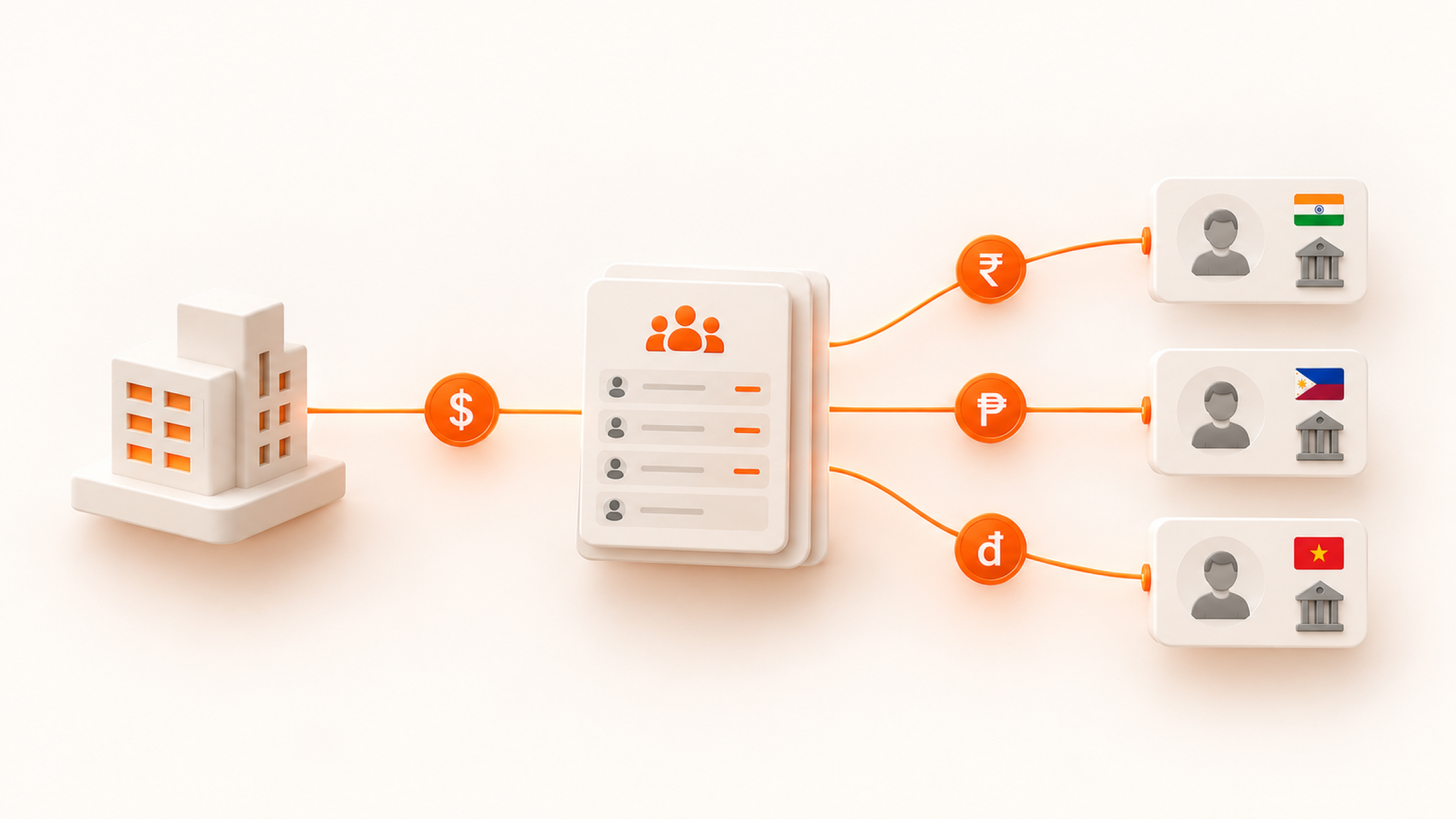
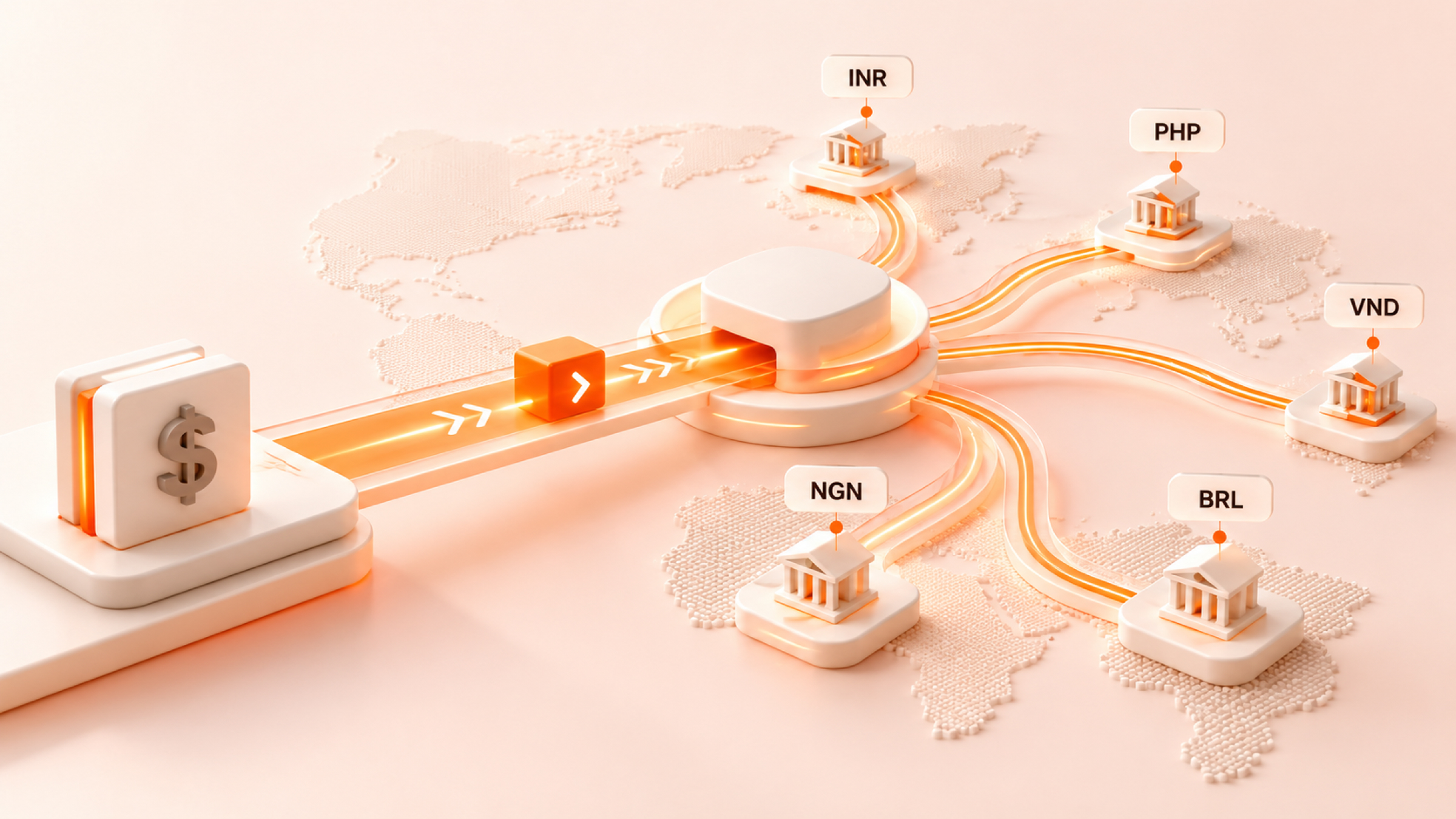
Five corridors settle in local currency today: the United Arab Emirates in dirhams, India in rupees on both the non-NRE and NRE routes, the Philippines in pesos, and the Netherlands in euros under SEPA. The 171 countries figure quoted widely across this category is US dollar reach, not local-currency payout coverage, and the two are not the same thing.
Settlement is instant across supported corridors, and next business day where the local rail clears on a cycle. You see one stated rate, quoted before the payment is sent and unchanged when it lands.
Ask us for the corridor-level detail in writing before you send a first payment, and hold every other provider to the same standard.
What to do before your next payment run
Four steps, in the order that saves the most time.
- Trace one completed payment from last quarter. Which institution credited the account, what record was created in the destination country, and what document your counterparty received. If you cannot reconstruct it, your provider may not be able to either.
- Look up your provider's registration yourself. Four minutes in a public registry.
- List your corridors and find the instrument governing each. One line per corridor, naming the regulator and whether the framework is in force or pending.
- Put the six questions above to your current provider in writing. Written answers are the asset, and they are what your auditor will ask for.
Start with KYB if you are still onboarding. If you want the corridor-specific version of the six questions answered for your own volumes, start at zpayments.zoth.io.
Read next: How to pay Indian contractors from stablecoins and FIRC explained: when an Indian exporter needs one
*Last reviewed: 17 September 2026. This article describes regulatory frameworks in general terms and is not legal or tax advice. Rules change frequently, and several frameworks referenced here are pending implementation.