Sanctions Screening for Cross-Border Payments
Key Highlights
- OFAC states there is no minimum or maximum transaction value subject to its regulations, and applies strict liability, so a provider screens a $50 payment on the same basis as a $500,000 one.
- Screening runs against several government lists, then runs again after approval, because designations change daily.
- On 13 October 2026 the United States Treasury settled with one bank over 475 apparent sanctions violations, naming poor alert calibration and slow watchlist updates among the causes.
- Sanctions are foreign policy. A designation becomes real when a payment does not arrive, which is why the obligation sits with whoever moves the money.
- The question for a payments team is not whether a provider screens, but how fast it resolves a match and what it may disclose while a payment waits.
What does sanctions screening mean in cross-border payments?
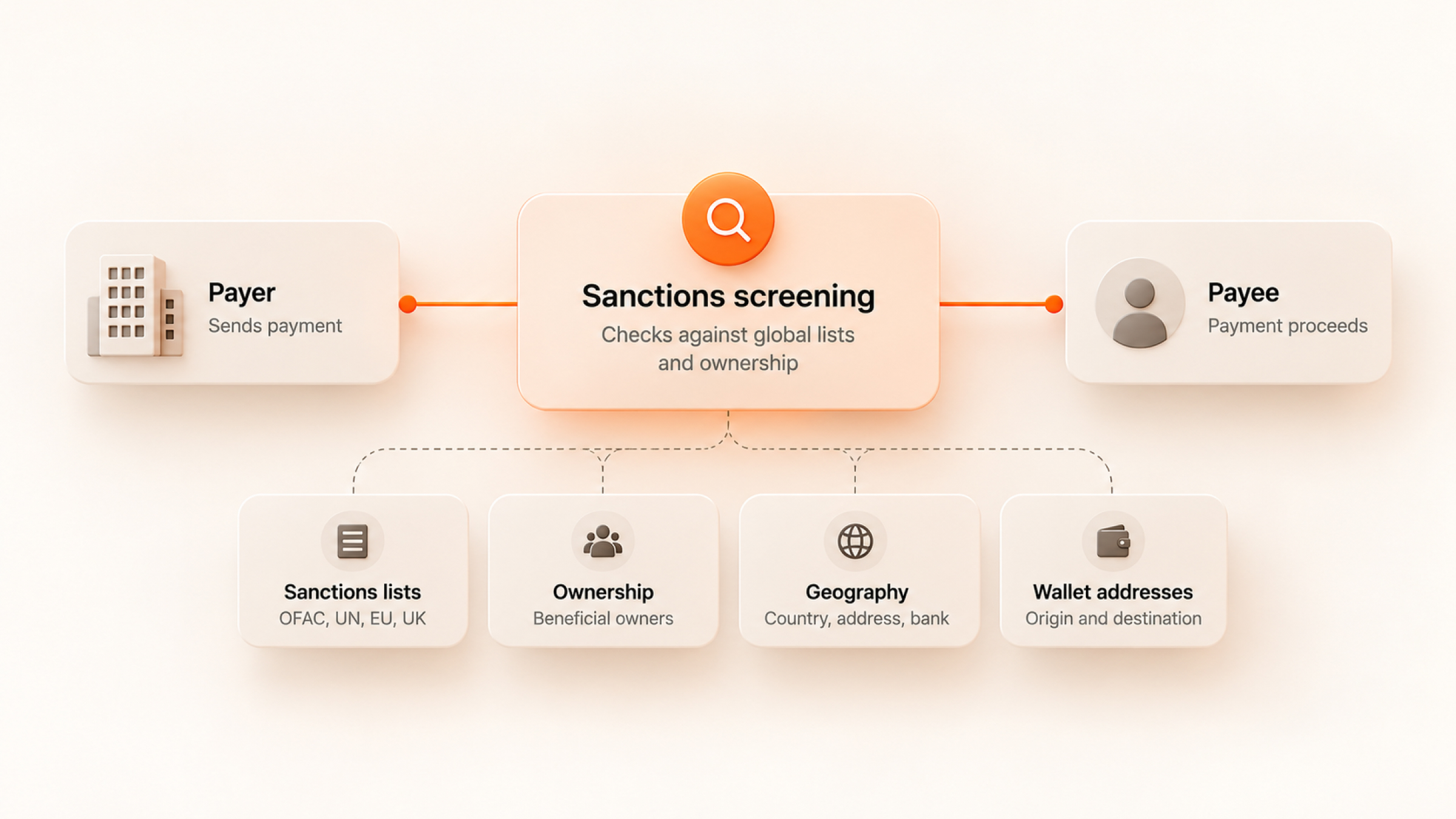
Sanctions screening is the process of checking the parties to a payment, and the data travelling with it, against lists of individuals, entities, vessels, countries and wallet addresses that a government has restricted dealings with. It runs before funds move and continues once a relationship exists.
A sanctions list is the published output of that restriction: OFAC's Specially Designated Nationals and Blocked Persons List, the United Nations Security Council Consolidated List, the European Union consolidated list, and the United Kingdom list held by the Office of Financial Sanctions Implementation.
A match, or alert, is the engine's statement that a name resembles a listed name closely enough to need a human decision. Most alerts are false positives, and all of them stop the payment until somebody clears them.
Sanctions screening is not a tax on speed that a better provider removes. It is a legal obligation that a better provider resolves faster, and resolution time is the variable that separates two providers quoting the same corridor on cross-border payments.
Three consequences follow from that, and they surprise most payers.
There is no minimum. A fifty dollar test payment is treated on the same basis as a five hundred thousand dollar invoice. Nothing in the rules creates a threshold below which screening can be skipped.
Liability does not require knowledge. OFAC may impose civil penalties on a strict liability basis, so an institution can be held liable for a payment it had no reason to suspect.
The obligation is immediate. FATF Recommendations 6 and 7 require targeted financial sanctions to be implemented without delay. A designation published this morning binds this afternoon's payment.
Sanctions screening is not only a United States question
OFAC is the most cited authority, but it is not the only one. The United Nations Security Council, the European Union and the United Kingdom each maintain their own regimes, and a single cross-border payment can fall inside more than one of them at once, depending on the currency it settles in, the banks it passes through and where the parties are established. A payer in Singapore sending to Manila is not outside the question simply because neither end is American.
Why does sanctions screening exist?
Sanctions are an instrument of foreign policy, not a banking rule. When a government wants to cut a person, a company or a regime out of the international financial system without resorting to force, it designates them. The designation is the policy.
On its own, though, a designation is only a name on a published list. It becomes real at the moment a payment to that name does not arrive. Sanctions work because payment systems enforce them, which is why the obligation falls on the institutions that move money rather than on the governments that write the lists.
The scope is wider than most payers assume. The United Nations Security Council Consolidated List alone named 736 individuals and 274 entities as at 15 October 2026, and it is one regime among several that a single payment can touch. Designations cover people, companies, vessels and aircraft, across programmes aimed at terrorism, narcotics, proliferation and particular states, and the lists change constantly as policy changes.
For a payments team the consequence is straightforward. Every cross-border payment is a point at which a designation is either enforced or it is not, and the institution carrying the payment is the one answerable for which. That responsibility is what the checks exist to discharge.
Four sanctions screening failures a regulator named in 2026
Enforcement records show how screening breaks on cross-border payments. A 2026 OFAC settlement resolved 475 apparent violations across seven sanctions programmes, among them Russia, Iran and global terrorism, for $11.6 million.
OFAC attributed them to four causes: correspondent payments routed through blocked banks by technical and human error, alerts calibrated so poorly that designated individuals could transact, watchlists left un-updated after designations, and accounts linked to blocked persons handled manually.
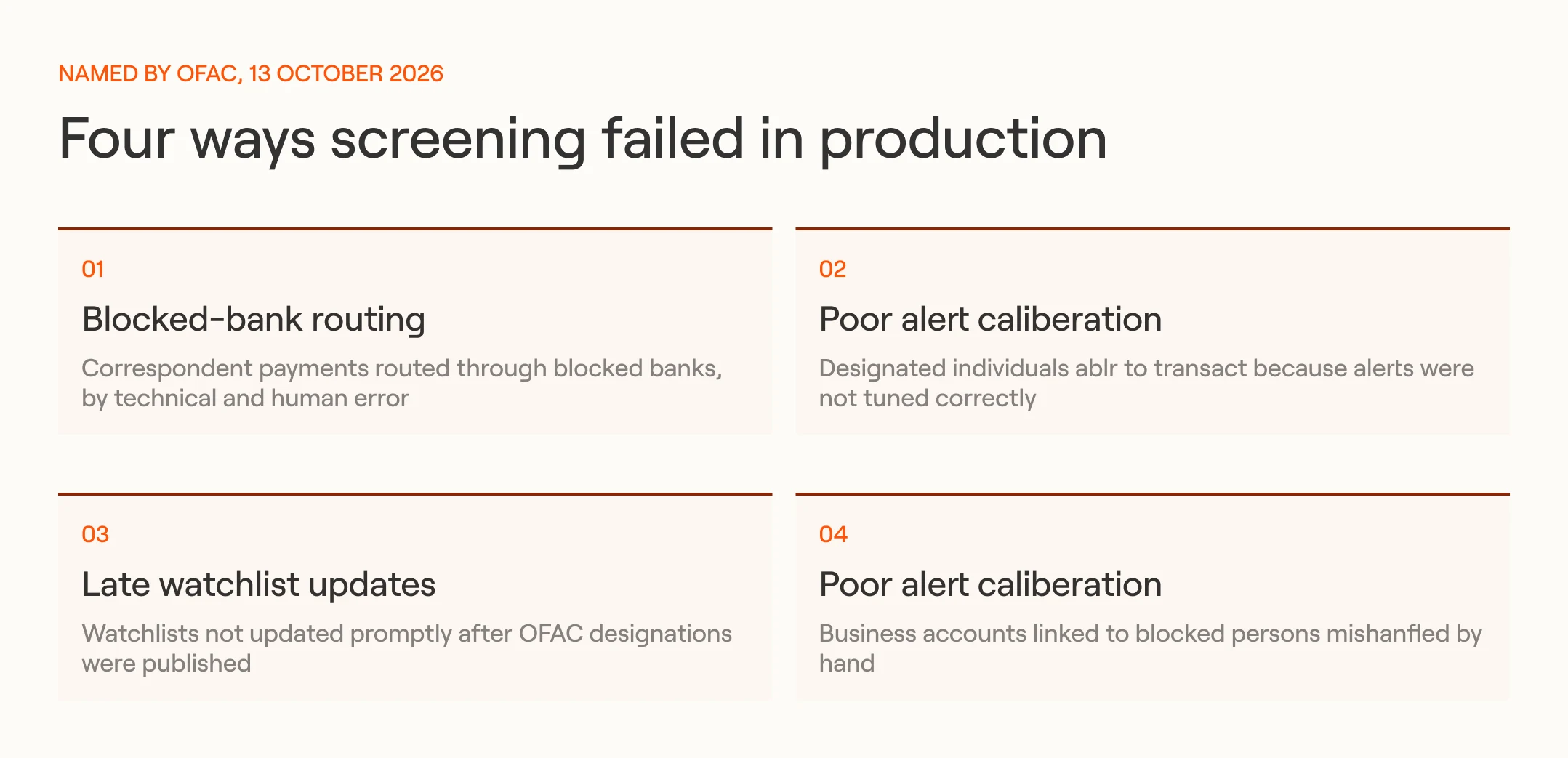
Three of the four are operational rather than legal, and all four convert into questions a buyer can put to a provider before signing. Testing and auditing is one of the five components OFAC expects in its Framework for OFAC Compliance Commitments, and it is the component that catches calibration drift.
What does a sanctions screening hold cost?
Nobody prices a held payment, which is why nobody manages it. The cost has two inputs: how often holds happen, and what each one takes to clear.
Frequency is a function of how many times a payment is screened. A wire crossing the correspondent network passes four or five independent engines. A stablecoin payout passes fewer. If each engine carries the same chance of a false positive, the chance of at least one hold compounds with the number of engines.
| Per-engine false-positive rate | A wire, five engines | A stablecoin rail, two engines |
|---|---|---|
| 0.5% | 2.5% held | 1.0% held |
| 1% | 4.9% | 2.0% |
| 2% | 9.6% | 4.0% |
| 3% | 14.1% | 5.9% |
The ratio sits near 2.4 to 1 across the whole range, which is the useful part. A payer does not need to know their own false-positive rate to see that screening a payment five times produces roughly two and a half times the holds of screening it twice.
Cost per hold is the input only the payer has. At a 1% per-engine rate, 1,000 payments a month and one hour of treasury time to clear each one, those two columns are 588 hours a year against 240. Nine working weeks.
Three numbers decide this: payments a month, time to clear one hold, and the hold rate. A finance team already holds the first two. The third, the hold rate last quarter, most cannot produce, and that absence is itself the finding.
What should a Head of Payments ask about sanctions screening?
Five questions, and what the answers tell you.
| What to ask | A good answer | A bad answer |
|---|---|---|
| Which lists, and how often they refresh | Names the lists, and a refresh measured in hours or on designation | "All the major lists" |
| Median and worst-case time to clear a false positive | Two figures, from logs, with the corridor they were measured on | "Usually same day" |
| Who resolves an alert, and how to reach them | A named team and a channel you can use | "Our compliance function reviews it" |
| How screening is calibrated and tested | A review cycle, and who reviews it | "It is continuously monitored" |
| What can be disclosed during a hold | Separates a hold they are free to explain from one connected to a filed report, which no provider may disclose | "We cannot comment on holds" |
Where a hold relates to a filed report, a provider may not say so. Where it does not, silence is a service failure, not a legal constraint. The same test applies when selecting an international payments provider.
Where zPayments sits in sanctions screening?
Screening, Travel Rule handling and monitoring run inside the platform. The sender’s own regulatory obligations remain the sender’s, and so does the accuracy of the beneficiary and ownership data those checks run against.
Zoth Payments Limited is registered as a Money Services Business with FINTRAC under registration number C10001622, which is a registration rather than a license, and cross-border payments settle through partners regulated in each corridor.
Put the five questions above to whoever moves your money today. If the answers come back in adjectives rather than figures, that is your answer. Ask us the same five and we will put ours in writing.
Read next: The travel rule for stablecoin payments
This article describes regulatory frameworks in general terms and is not legal advice.
Frequently asked questions
What is sanctions screening in cross-border payments?
It is the check that compares the parties to a payment, and the data travelling with it, against lists of individuals, entities, vessels and countries that governments have restricted dealings with. It runs before funds move and continues for as long as the relationship exists.
Why does sanctions screening matter?
Because it is a legal obligation rather than a service level, and it sits on the regulated institution moving the money. Failing it is not a customer service problem. It is an enforcement matter, and penalties are assessed against the institution regardless of intent.
Is there a minimum payment value below which screening does not apply?
No. OFAC states there is no minimum or maximum amount subject to its regulations, and it applies strict liability, so small test payments are treated on the same basis as large invoices. Thresholds apply to other obligations, such as recordkeeping and travel rule data, not to screening.
Who is liable when a sanctioned payment is processed?
Liability sits with the regulated institution that processed it, and OFAC can impose civil penalties without proof of knowledge. The payer carries its own obligations separately, including the accuracy of the beneficiary and ownership data supplied.
How often should sanctions lists be updated?
Continuously. FATF Recommendations 6 and 7 require targeted financial sanctions to be implemented without delay, so a designation published in the morning binds the same day's payments.
Does sanctions screening apply outside the United States?
Yes. The United Nations Security Council, the European Union and the United Kingdom each maintain their own regimes, and a single cross-border payment can fall inside more than one at once, depending on the currency it settles in, the banks it passes through and where the parties are established.
Does sanctions screening apply to stablecoin payouts?
Yes. A stablecoin payout is a cross-border payment and the same obligations apply to it. The rail does not change the legal position.