
What Is a Stablecoin Sandwich in Cross-Border Payments?
Key highlights
- A stablecoin sandwich is a payment structure with three legs: local currency in, a stablecoin on-chain in the middle, local currency out.
- Standard Chartered's Global Head of Payments described the model at Sibos 2026 as the way institutions stitch stablecoins into the hard-to-reach leg of a payment.
- The payer and the beneficiary stay in fiat. Neither side needs to hold a stablecoin.
- Each leg of the transaction carries its own cost: an on-ramp fee going in, a network fee in the middle and a conversion rate coming out.
What is a stablecoin sandwich?
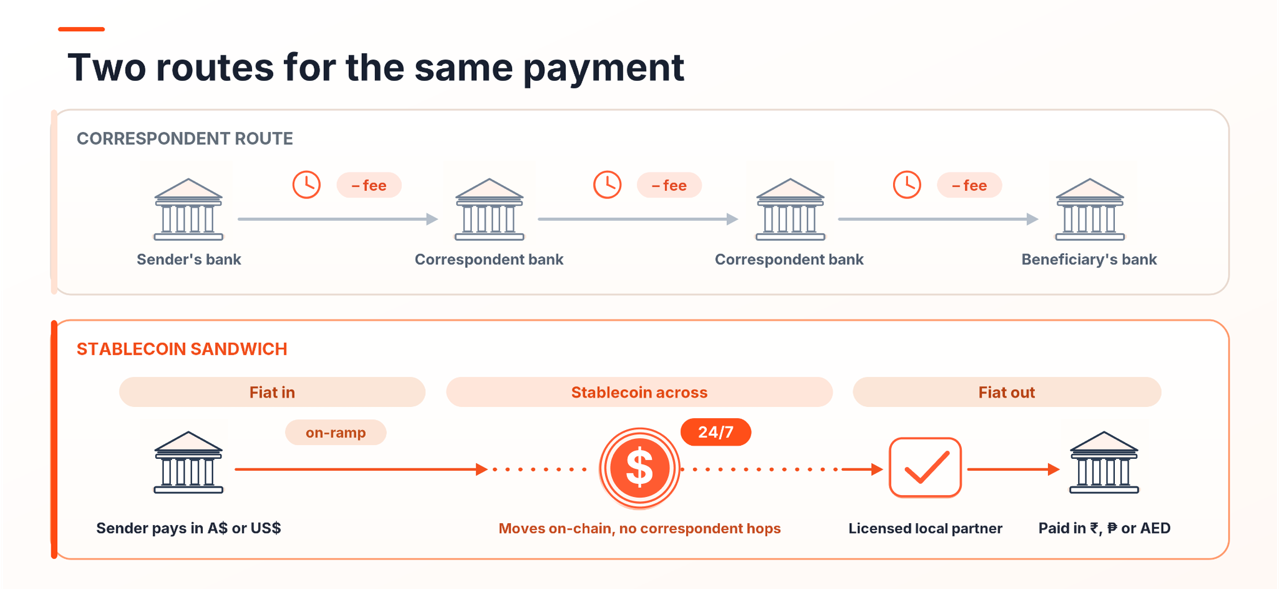
A stablecoin sandwich is a cross-border payment in which a stablecoin carries value between two fiat legs. The payer funds in its home currency, the value moves as a dollar stablecoin such as USDC, and the beneficiary is credited in local currency to a bank account.
Three definitions, by role:
- For the payments team, it is a routing design. The stablecoin replaces the correspondent chain in the middle leg, and domestic rails handle both ends.
- For a CFO, it is a funding model. Value crosses the border without a standing balance parked in the destination country.
- For a bank, it is a settlement layer. The stablecoin does the work on one leg of the journey and nowhere else.
That last framing comes from the banks themselves. In a Sibos 2026 interview, Naveen Mallela, Global Head of Payments at Standard Chartered, discussed the stablecoin sandwich as institutions stitch stablecoins into the hard-to-reach legs of a payment, alongside tokenised deposits and domestic instant payment schemes. That puts the model in the vocabulary banks already use for cross-border payments.
Why the stablecoin sandwich exists
Conventional cross-border payments pass through a chain of correspondent banks. Each link adds a cutoff, a fee and a check, and the sending side typically holds prefunded balances in the destination currency.
The public data shows the cost of that chain. The Reserve Bank of Australia estimates that only about 34% of Swift cross-border payments into Australia completed within one hour in 2023/24, against a G20 target of 75%.
The picture is sharper in Japan. The World Bank recorded Japan’s average cost of sending $200 rising from 7.11% to 9.98% in Q3 2025, the largest increase in the report, against a global average of 6.36%.
How a stablecoin sandwich works, leg by leg
Leg one: fiat in
The payer converts its home currency into a stablecoin through a regulated on-ramp, or funds the payment from a stablecoin balance it already holds.
Leg two: the stablecoin transfer
Value moves on a public blockchain at any hour, including weekends. Nothing waits in a correspondent queue, so the middle leg no longer depends on two banks’ business days overlapping. That matters in APAC: the RBA names Australia’s time zone as a likely key factor delaying its cross-border payments.
Leg three: fiat out
A licensed local partner converts the stablecoin and credits the beneficiary through the domestic rail. Local liquidity sets the price: the depth of this leg decides what the beneficiary receives and when.
| Leg | What happens | What sets the price | What to check |
|---|---|---|---|
| Fiat in | Home currency converts to a stablecoin | On-ramp fee and conversion rate | Funding from an existing balance |
| The middle | The stablecoin moves on-chain | Network fee | Chain, and the fee on the quote |
| Fiat out | The stablecoin converts and pays out locally | Local liquidity and the domestic rail fee | Rail cutoff and delivery time |
What the stablecoin sandwich changes for payments and finance teams
The model changes the middle of cross-border payments, not their endpoints. Cutoffs, weekend gaps and nostro reconciliation shrink in the middle leg. Licensing, onboarding and screening obligations stay where they are, and destination-country rules still govern the last mile.
Some corridors are closing the gap another way. Through Nexus, the central banks of India, Indonesia, Malaysia, the Philippines, Singapore and Thailand are linking their domestic instant payment systems. Australia and Japan sit outside that network, so payments from those markets still need another route across the border.
The choice of middle asset also carries regulatory weight. The European Banking Authority named USDC MiCA’s first significant e-money token, which moves oversight of USDC’s reserves and liquidity to the EBA from 12 November 2026.
Who benefits from a stablecoin sandwich
The model fits businesses that make recurring international payouts into markets where correspondent banking is slow, costly or operationally complex. That includes payroll providers, marketplaces paying sellers abroad, remittance businesses, importers and exporters, and companies paying contractors across several countries.
Measuring the return on a stablecoin sandwich
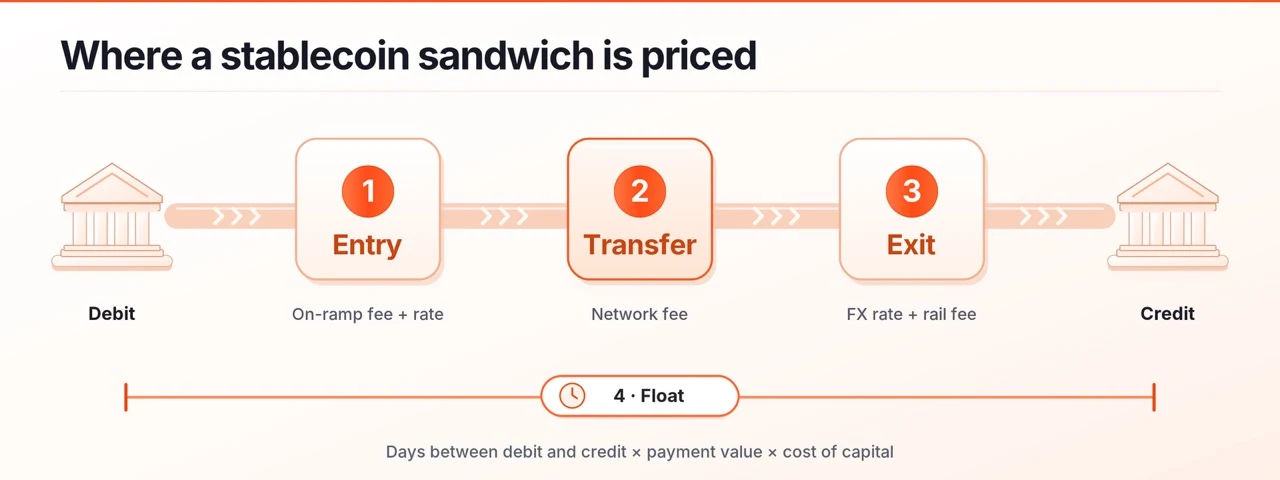
A CFO prices the stablecoin sandwich the way it is built: one leg at a time, then the time between debit and credit. The return is the gap between that total and today’s all-in cost.
- Entry cost: the on-ramp fee and rate on leg one. Nil where funding comes from a stablecoin balance the business already holds.
- Transfer cost: the network fee on leg two.
- Exit cost: the conversion rate and rail fee on leg three, measured against the mid-market rate.
- Float cost: days between debit and beneficiary credit, multiplied by payment value and cost of capital. Weekends and holidays count.
Today’s all-in cost is the bank fee, intermediary deductions and the gap between the rate applied and the mid-market rate, explained in what FX spread costs a business.
A worked baseline shows the scale. The RBA puts the average cost of sending A$1,000 from Australia to South Pacific countries at 6.4%. Applied to A$500,000 of monthly payments into the region, that rate comes to about A$32,000 a month, or A$384,000 a year. The RBA figure is a retail benchmark for A$1,000 transfers, so it illustrates the calculation rather than a business quote.
Pricing legs two and three with zFX
The network fee and the conversion rate sit inside the amount that lands, not on an invoice.
zFX, the live payout calculator from Zoth Payments Limited, shows both. Enter a USDC amount, choose INR, AED, PHP or PKR, and it returns the current conversion rate, the network charge and the amount credited.
Those three figures turn exit cost and transfer cost into quoted numbers. Run a recent payout’s amount and compare the result with what that payout delivered.
Running payouts across emerging markets? Audit your cross-border payout fees with an International Payment Specialist at Zoth, today.
The stablecoin sandwich at Zoth Payments Limited
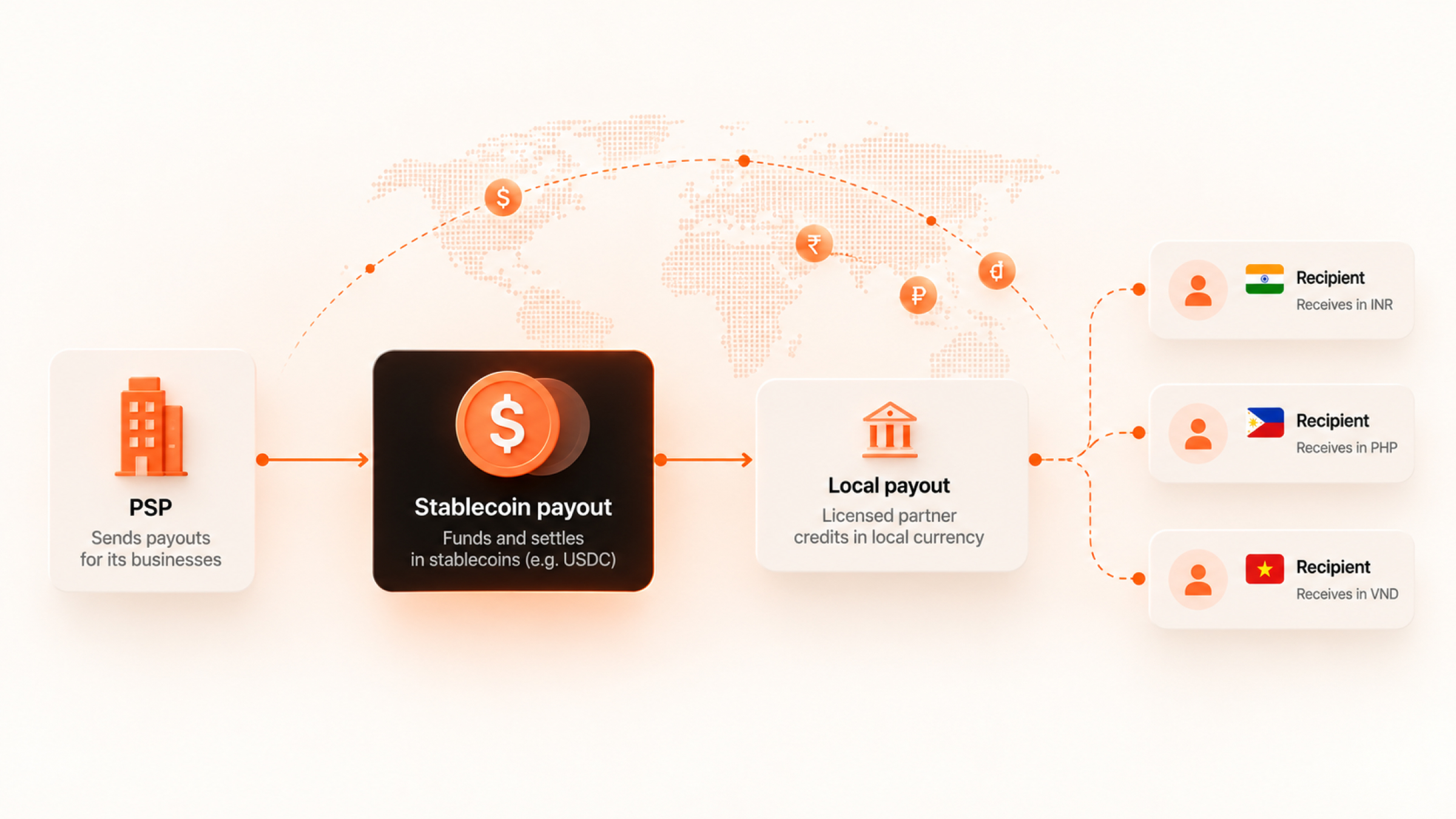
zPayments, from Zoth Payments Limited, a FINTRAC-registered money services business in Canada, runs all three legs in one flow: payouts funded in USDC, on-chain settlement, and same-day local delivery through licensed partners on supported corridors, at a disclosed rate. Screening, KYB, monitoring and Travel Rule checks run inside the platform, as set out on the zPayments page.
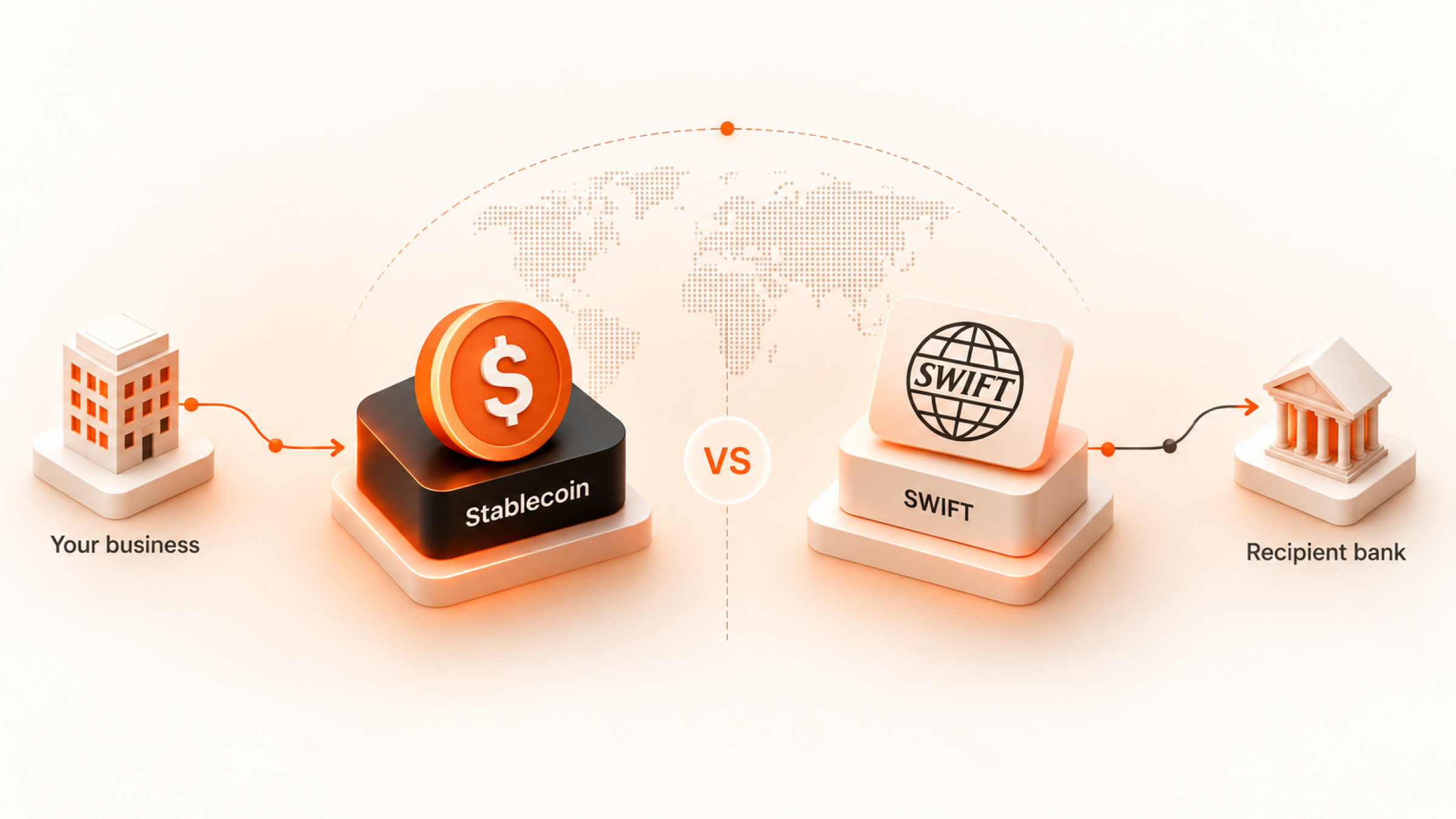
For how each leg compares with a wire, see stablecoin vs SWIFT.
Frequently asked questions
Where does the term stablecoin sandwich come from?
Payments practitioners use it for the shape of the payment: a stablecoin layer between two fiat layers. Standard Chartered used the term at Sibos 2026 to describe how institutions are adopting stablecoins.
Is a stablecoin sandwich the same as tokenised deposits?
No. A tokenised deposit is a claim on the issuing bank, recorded on a ledger. A stablecoin sandwich uses a stablecoin that moves across institutions. Standard Chartered treats the two as complementary.
Does a stablecoin sandwich remove FX cost?
No. Conversion still happens on legs one and three. The difference is where the rate is set: at the destination, by local liquidity, rather than stacked across correspondents.