Stablecoin Payouts for PSPs
Key highlights
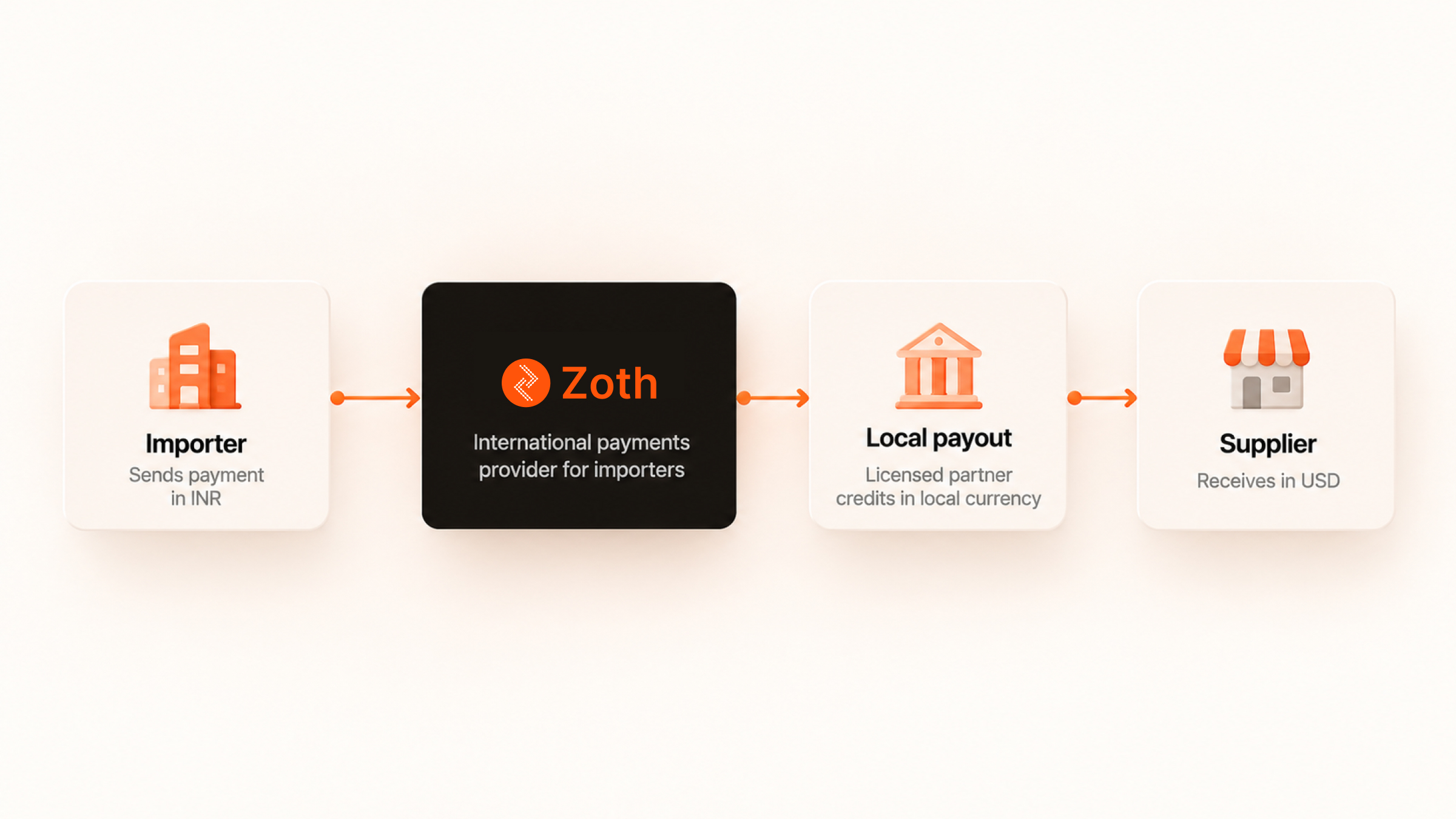
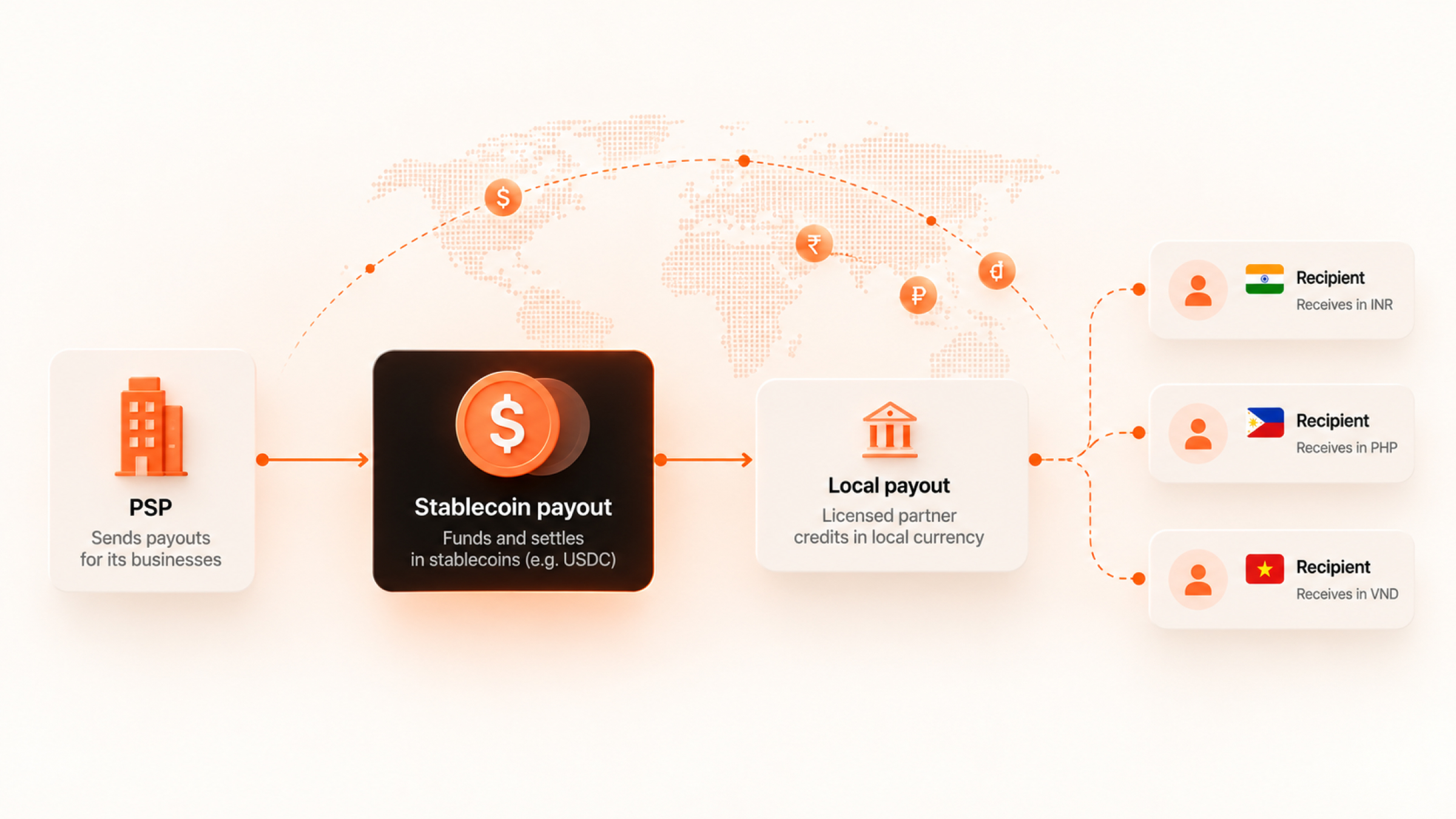
- Stablecoin payouts for PSPs change the funding leg of a cross-border payout. The last mile stays local: a licensed partner credits the beneficiary in local currency.
- The Financial Stability Board's 2025 progress report found that fewer than 45% of business-to-business (B2B) and business-to-person (B2P) cross-border payments settled within one business day.
- The business case rests on four measurable lines: capital held in prefunded positions, FX cost per corridor, operating cost and time to open a new corridor.
- Local liquidity sets the price: corridor partners, quote holds and cutoffs decide the outcome.
What are stablecoin payouts for PSPs?
A payment service provider (PSP) moves money on behalf of other businesses. The category covers payout platforms, payroll and employer-of-record providers, marketplaces paying sellers abroad, and money transfer operators.
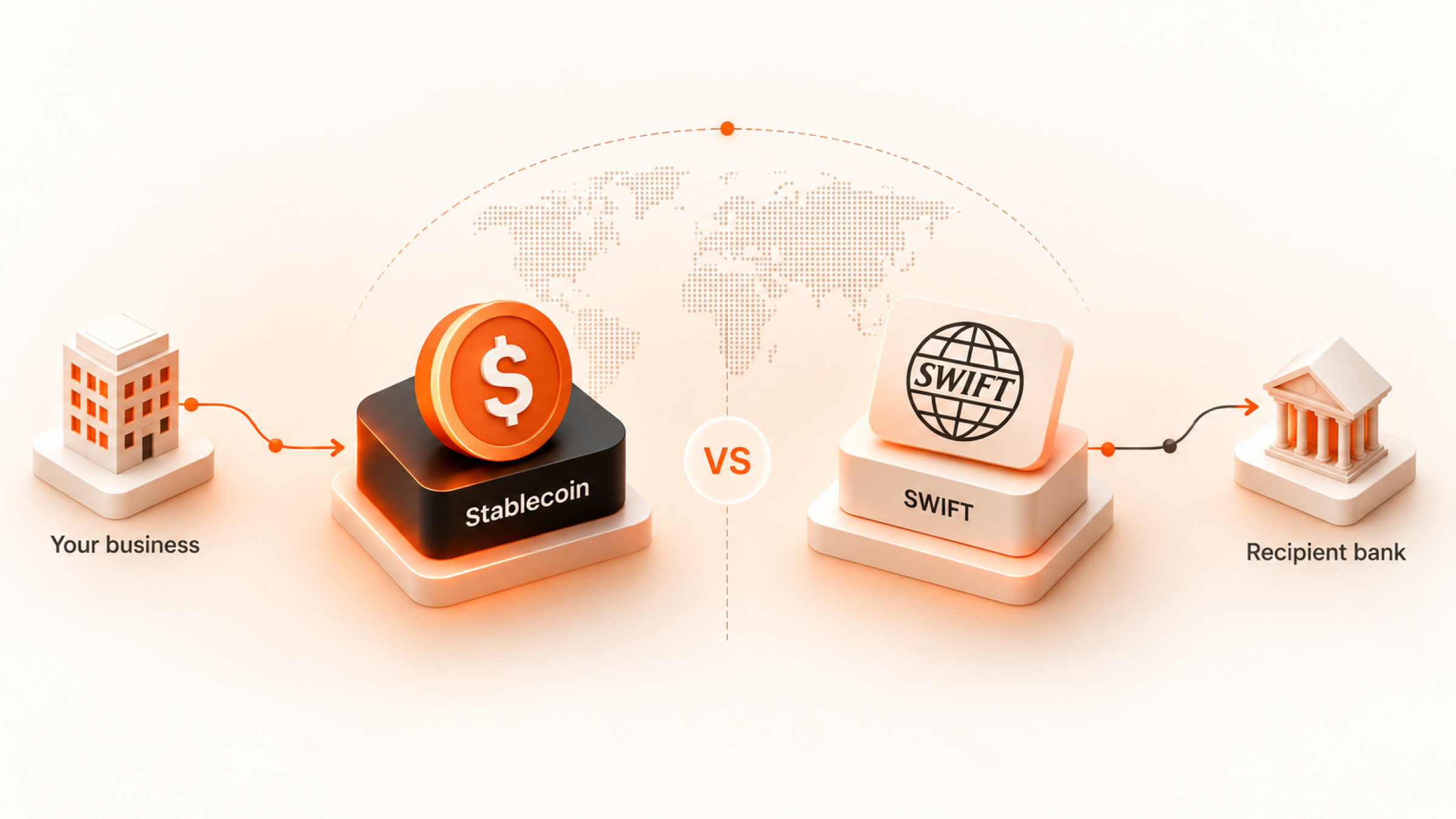
A stablecoin payout is a cross-border payout funded in a regulated, fiat-referenced stablecoin such as USDC and delivered to the beneficiary in local currency over a domestic payment rail. The mechanics are covered in what a stablecoin payout is and how it works.
Stablecoin payouts for PSPs apply that model to the PSP's own payout book. The PSP funds and settles its clients' payouts in stablecoins, while each beneficiary still receives local currency in a bank account or wallet.
The question a Head of Payments asks about stablecoin payouts for PSPs is narrow. Which part of the current cross-border payout chain does the stablecoin leg replace, and what does that change on the balance sheet?
Why stablecoin payouts for PSPs are on the agenda in 2026
The correspondent model has not closed the gap
The FSB's consolidated progress report for 2025 states that the G20 targets are unlikely to be met by end-2027. Fewer than 45% of B2B and B2P payments settled within one business day.
Prefunding ties up the PSP's capital
A PSP that pays out through local partners usually holds money in each destination before its clients send funds. The prefunded balance equals daily payout volume multiplied by the settlement lag in days. Each new corridor adds another balance to fund and reconcile, a pattern set out in how zPayments replaces nostro prefunding for MTOs.
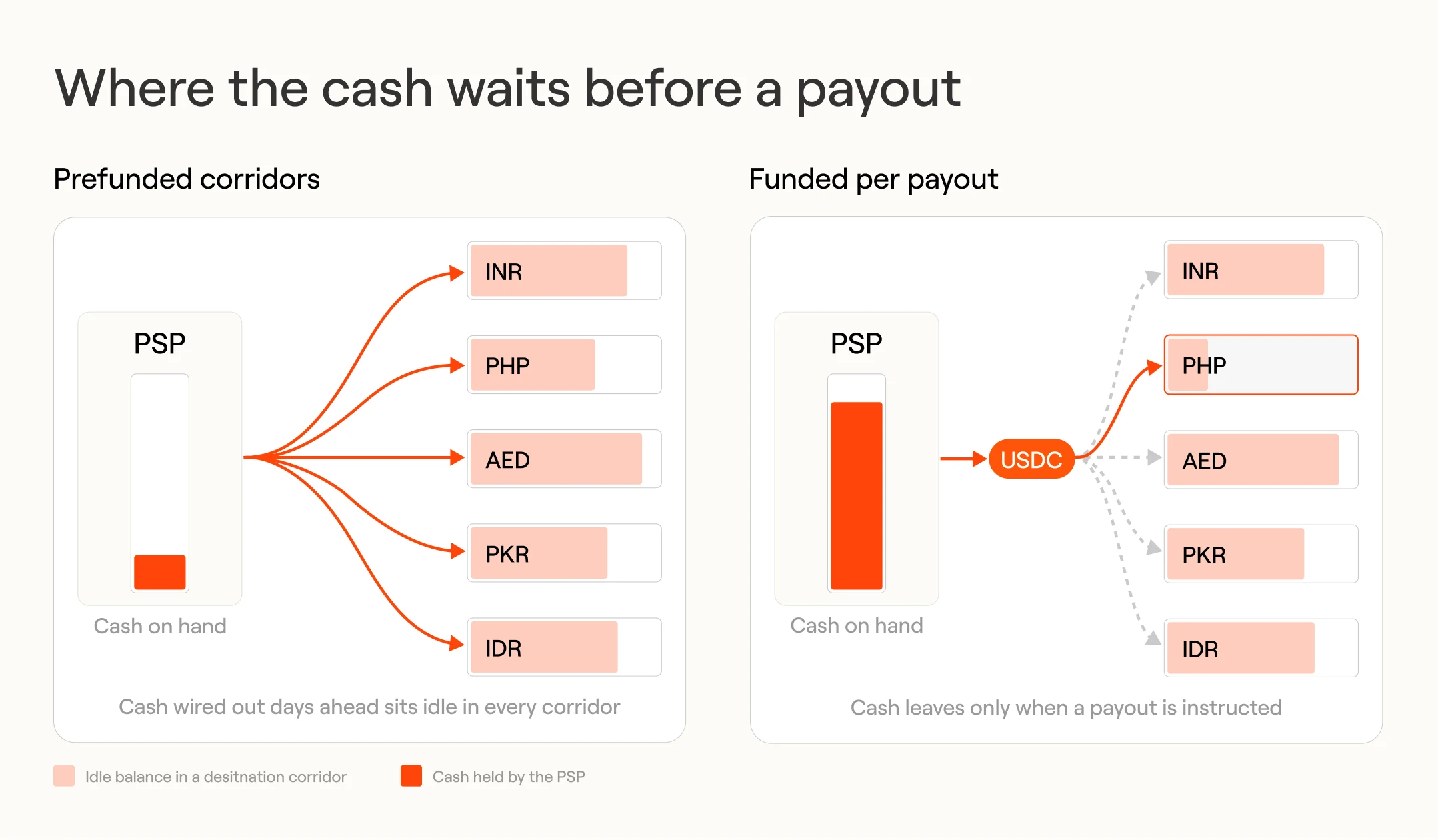
The CPMI examined this in its October 2023 report on stablecoin arrangements. It found that fewer links in the payment chain are likely to reduce funding needs tied to prefunded or overfunded accounts, provided a common platform actually removes intermediaries.
The card networks have moved
On 15 October 2026, Visa announced that Visa Direct clients can now prefund payouts in USDC in near real time. The same day, Mastercard launched Global Money Platform, which pays local bank accounts from stablecoin balances. Stablecoin payouts for PSPs are now a production option at the largest networks. Funding each payout at instruction goes further and removes the standing balance.
What changes with stablecoin payouts for PSPs, and what stays
| Layer | Correspondent model | Stablecoin model |
|---|---|---|
| Funding | Balances wired into each corridor days ahead | Funded per payout or per batch, 24/7 |
| Conversion | Can occur at more than one hop | Quoted before authorisation |
| Last mile | Local bank | Licensed local partner on the domestic rail |
| Compliance | PSP's own licences and controls | Unchanged; Travel Rule data travels with the payout |
| Reconciliation | One statement per corridor balance | Payout-level status in one ledger |
Two things do not change: the destination rail still sets the clock, and the licensing and reporting obligations stay with the PSP.
How to implement stablecoin payouts for PSPs
1. Map the corridor book
For each corridor, record daily volume, settlement lag, prefunded balance, effective FX rate and failure rate.
2. Choose the settlement asset
Compliance teams need a documented supervisory status for the asset. On 14 October 2026, the European Banking Authority classified USDC as the first significant e-money token under MiCA, with EBA supervision of its reserves and liquidity from 12 November 2026.
3. Decide whether to build or partner
Building means sourcing licences, liquidity providers and rail access in every market. Partnering means one integration with a payout provider whose licensed partners already operate in each corridor.
4. Pilot one corridor
A pilot of stablecoin payouts for PSPs works best on the corridor carrying the largest prefunded balance or the longest lag. Run it alongside the existing route and compare landed amounts and settlement times.
5. Wire in compliance and reconciliation
The revised FATF Recommendation 16 standardises the originator and beneficiary data that must travel with a cross-border payment. Screening, Travel Rule data, maker-checker review and an auditable record belong in the flow from the first live payout. The checks are set out in Zoth's guide to the Travel Rule for stablecoin payments.
Questions to ask a provider of stablecoin payouts for PSPs
- Which licensed partner pays out in each corridor, and in which currency?
- Is the quoted rate held, and for how long?
- What are the cutoffs, and when does each local rail settle?
- Where do funds sit if a payout fails, and how are they returned?
- Which screening and Travel Rule data accompanies each cross-border payout?
An ROI framework for stablecoin payouts for PSPs
A CFO evaluating stablecoin payouts for PSPs needs four lines, each measured per corridor.
- Capital released = (daily payout volume × settlement lag in days − residual funding position) × cost of capital.
- FX and fee delta = annual corridor volume × (current effective cost − quoted all-in cost).
- Operating cost = hours spent on reconciliation, exceptions and manual funding × loaded hourly cost, before and after.
- Corridor expansion = time and cost to open a new market under each model.
Net annual value equals the sum of lines one to three, less provider fees and conversion costs. Line four is strategic: it decides how fast the PSP can sell into a new market.
An illustration of line one: a PSP paying out $300,000 a day on T+2 holds about $600,000 in position. At an 8% cost of capital, that balance carries $48,000 a year before any FX or headcount effect.
Line two is the one a CFO can test directly. zFX prices a live payout in INR, AED, PHP and PKR, showing the rate, the network fee and the exact amount the beneficiary receives for any send amount. A CFO can run the largest corridor through it and compare the result with what the current provider delivered on the last payout.
Running payouts into corridors not listed here? Audit your payout costs with a cross-border payment specialist at Zoth.
How Zoth Payments Limited approaches stablecoin payouts for PSPs
zPayments is operated by Zoth Payments Limited, registered with FINTRAC as a money services business (C10001622). Payouts are funded in stablecoins and delivered in local currency across 171 countries through licensed partners in each corridor.
Before a payout is committed, the quote shows the rate, the itemised local network commission and the exact amount the beneficiary receives. KYB, screening, Travel Rule checks and monitoring run inside the platform, payouts pass maker-checker review, and each cross-border payout and its status sit in one auditable ledger. On-chain settlement clears in minutes; the destination rail sets local delivery time, and the cutoff is stated before sending.
Next step
A Head of Payments evaluating stablecoin payouts for PSPs can check live corridor rates and bring the figures to a zPayments walkthrough on the PSP's own corridors.
Frequently asked questions
What are stablecoin payouts for PSPs?
A PSP funds and settles its clients' cross-border payouts in a regulated stablecoin, and a licensed local partner credits each beneficiary in local currency.
Does the beneficiary receive stablecoins?
Not in the standard B2B model. The beneficiary receives local currency in a bank account or wallet.
Do stablecoin payouts remove prefunding?
They remove the standing balance the PSP holds in each corridor. Local currency must still be available at the moment of payout, and under a partner model the licensed partner carries it.
Which obligations stay with the PSP?
Licensing, reporting, screening and Travel Rule obligations. A payout provider can run checks inside its platform, but the PSP's regulatory duties do not transfer.
How should a CFO measure the return?
Measure capital released, FX and fee delta, and operating cost per corridor, net of provider fees, and then weigh the time to open new corridors.