Stablecoin vs SWIFT: What a Cross-Border Payout Costs
Key highlights
- SWIFT's own data: 89% of payments reach the recipient bank within an hour, but only 60% of wholesale payments reach the customer account in that window.
- The RBA measured a A$1,000 bank transfer at about 4% to advanced economies and about 6% to developing economies.
- In a stablecoin vs SWIFT comparison the blockchain leg is close to free. The local payout leg is not.
- Accenture and Mastercard both place the cost in last-mile liquidity rather than in the rail.
- Every 1% of combined spread and fees costs $20,000 a month on $2m of payout volume. The comparison is corridor by corridor, measured as landed amount.
Stablecoin vs SWIFT: two rails and four definitions
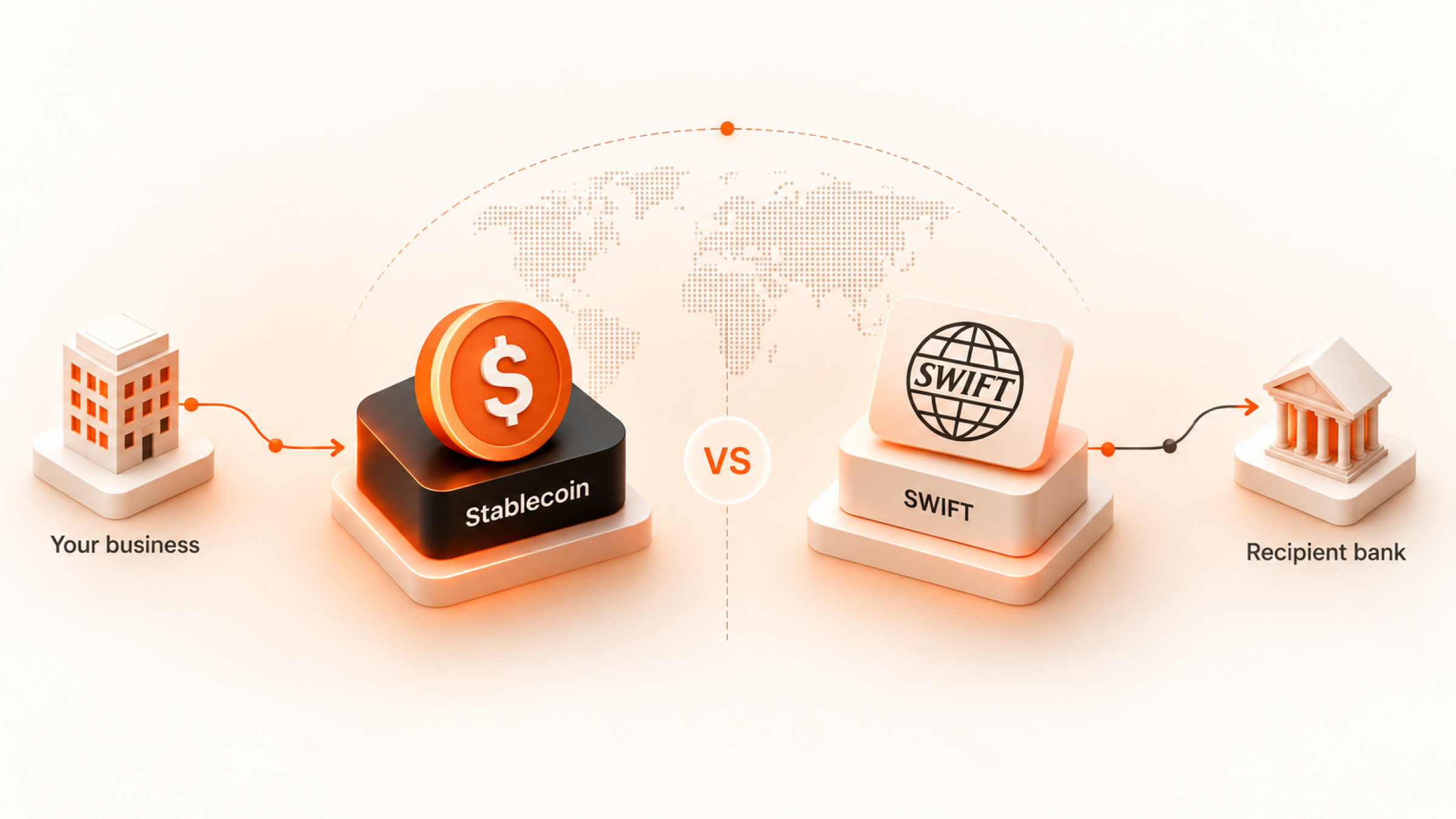
The stablecoin vs SWIFT question is usually framed as one cheap rail against one expensive one. The evidence is narrower. Most of the cost appears after the money reaches the destination country. Four definitions show why.
SWIFT is a member-owned cooperative that carries payment instructions between banks. It is a messaging network, not a settlement network. The money itself moves through correspondent banks, each pricing its own leg.
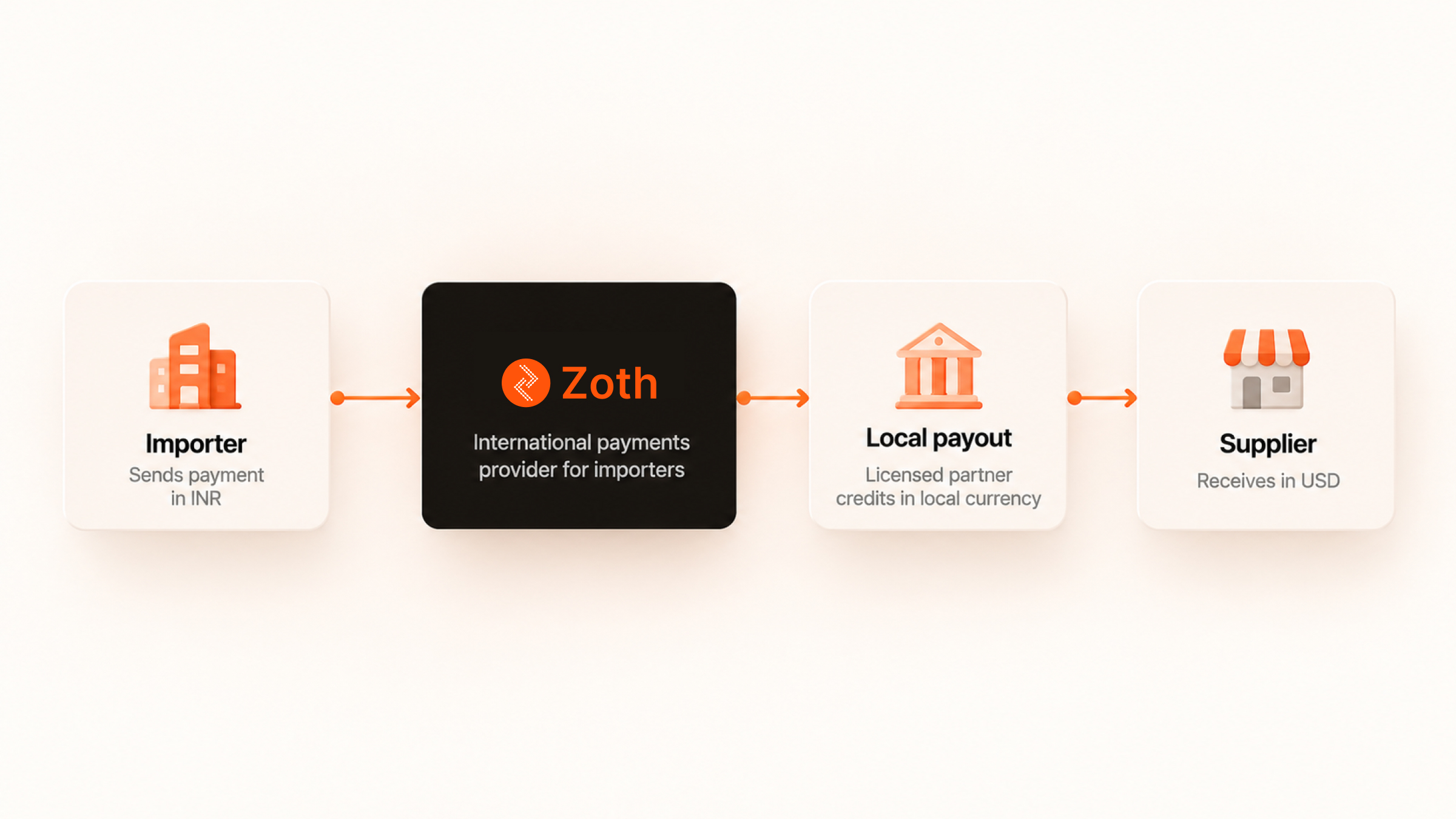
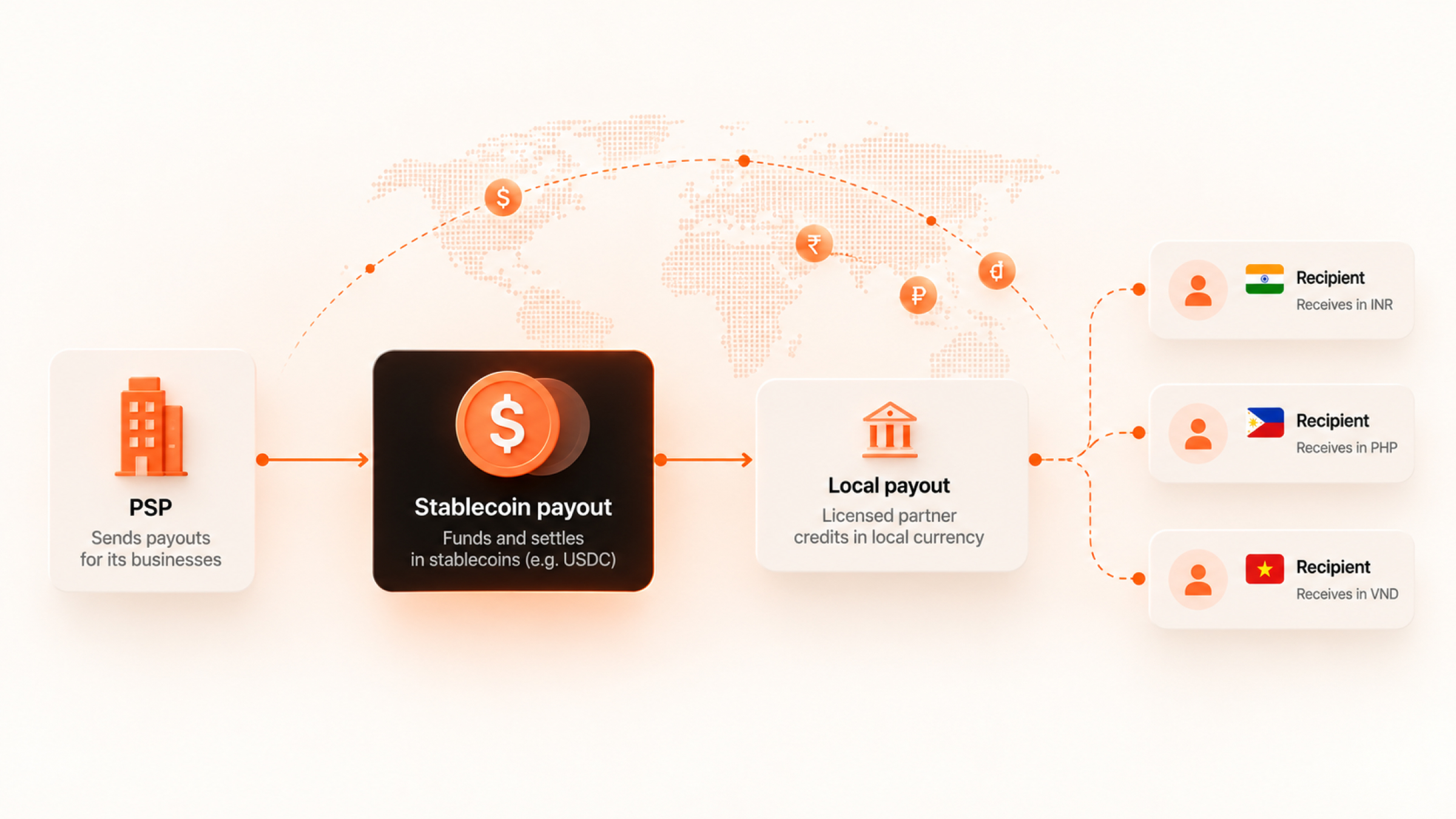
A stablecoin payment moves value on a blockchain in a token referenced to a fiat currency, then converts into local currency through a licensed partner at the destination. The steps are set out in what a stablecoin payout is and how it works.
Last-mile liquidity is the local currency a provider must hold, or buy, to pay the beneficiary. Neither rail avoids it, and almost every stablecoin vs SWIFT argument turns on it.
zPayments is a stablecoin payout provider that settles into local currency through licensed local partners across Global South corridors, funding each payout rather than holding standing balances in destination markets.
Stablecoin vs SWIFT on cost: what a bank payment charges
The wire fee is the smallest of the cross-border payout costs on a bank payment, and the only one most finance teams see on the statement.
MUFG publishes its corporate schedule: a JPY 7,000 outward remittance fee, a 0.050% exchange handling fee with a JPY 2,500 minimum, and a JPY 3,000 payer-bank fee. The telegraphic transfer spread applied to the conversion is not published, and in most corridors it exceeds every disclosed fee combined. The mechanics are in what FX spread is and what it costs a business.
Each correspondent in the chain may then deduct its own charge in transit, which is why a beneficiary receives less than the invoice states and nobody can say who took the difference. See intermediary bank fees.
The aggregate is measurable. The RBA found major banks charging about 4% on a transfer of A$1,000 to advanced economies and about 6% to developing economies, against about 2% at non-banks. The World Bank records payments into a bank account costing roughly twice those into a mobile wallet. Both datasets cover retail transfers, so they indicate the direction of corporate pricing, not its level.
Stablecoin vs SWIFT on cost: what a stablecoin payout charges
A stablecoin payout removes the correspondent chain and the network fee with it. On the chains used for business payouts the transfer costs cents. That saving is real, and nobody competes on it any more.
What remains is the last mile. Someone has to hold rupees, pesos or yen in the destination market, convert the stablecoin into them, and push the money through a local rail. That position carries a funding cost, the conversion carries a spread, and the rail charges a fee.
Both sides of the industry agree. Accenture's global head of payments, Sulabh Agarwal, names last-mile liquidity outside the G7 as the variable that decides end-to-end cost. Mastercard built the same logic into the Global Money Platform it launched in October 2026, which holds fiat and stablecoin balances side by side.
This is why the stablecoin vs SWIFT answer cannot be a single percentage. The rail sets the floor. Local liquidity sets the price. A provider with a funded partner in a corridor lands more money there than a bank wire does, whatever the chain costs.
Stablecoin vs SWIFT: the cost lines compared
The table sets the two rails against the five cross-border payout costs that decide the landed amount.
| Cost line | Bank payment over SWIFT | Stablecoin payout |
|---|---|---|
| Network or messaging fee | Sending wire fee, plus a payer-bank fee | Cents, and nil on several payment chains |
| FX conversion | Telegraphic transfer spread, usually unpublished | Spread on conversion into local currency |
| Intermediary deductions | Possible at each correspondent, taken in transit | None, as there is no correspondent chain |
| Local delivery | Beneficiary bank charge, set locally | Local rail fee, plus the cost of funding local currency |
| Working capital | Nostro balances held in destination markets | Funded per payout, as in replacing nostro prefunding |
The full anatomy of a single transfer is in the true cost of one payout.
Stablecoin vs SWIFT on speed and settlement certainty
Speed follows the same pattern. SWIFT reports 89% of payments reaching the recipient bank within an hour and 84% travelling directly or through a single intermediary, ahead of the G20 target. In the same data only 60% of wholesale payments reach the customer account inside that hour, held up by regulatory controls, batch processing and local market-infrastructure opening hours.
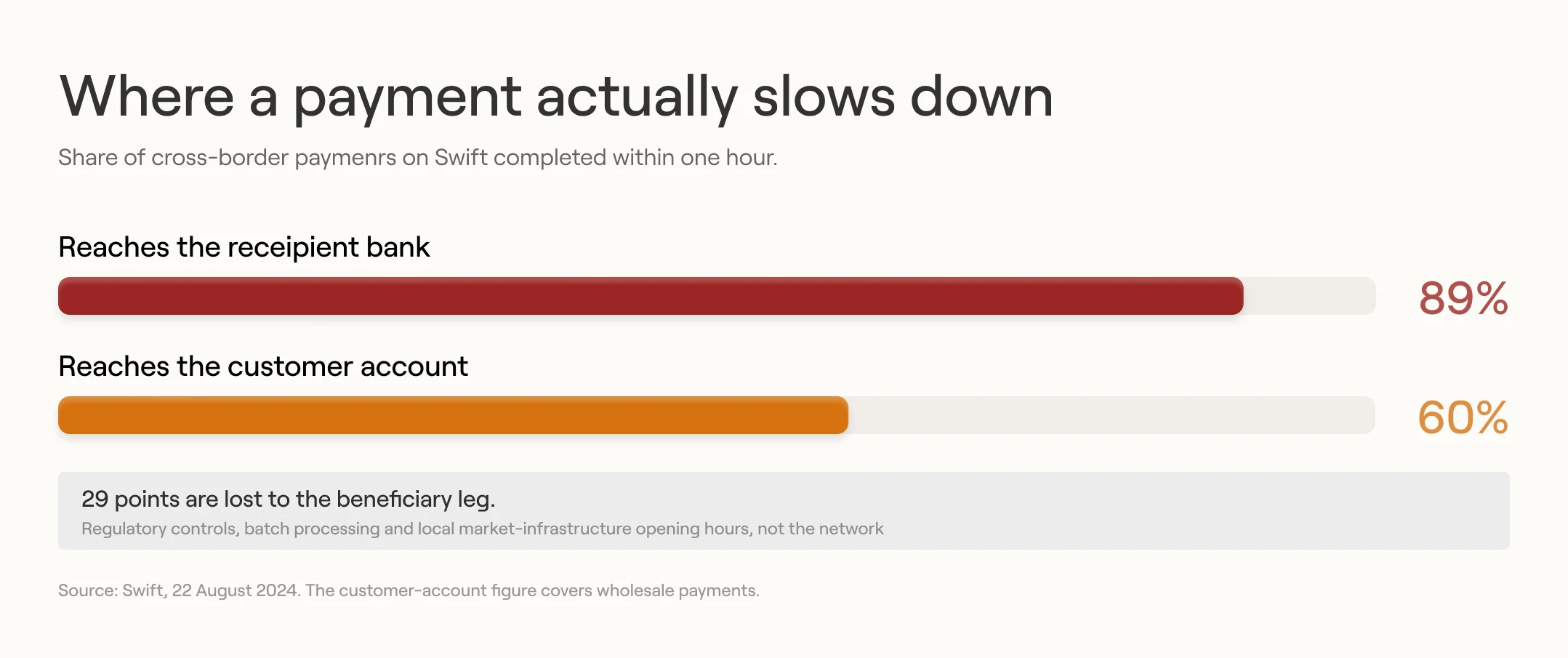
That is the finding that matters in any stablecoin vs SWIFT comparison. The in-flight leg was fixed years ago. The beneficiary leg was not.
A stablecoin transfer settles in minutes and observes no weekends or cut-off times. The local payout rail still does. Where the destination market runs a real-time scheme, funds can land outside banking hours. Where it does not, the payout queues behind the same batch window as a wire. Ask a provider for first-time completion in a named corridor, not an average.
How a finance team should test stablecoin vs SWIFT
A finance team does not need an industry view. It needs four numbers for its own three largest corridors.
- Landed amount, not headline fee. Send a fixed figure, for example $10,000, and record what the beneficiary receives in local currency the same day on each rail. Every one of the cross-border payout costs above shows up in that single number.
- The rate at the moment of sending. A quoted percentage is not a rate. zPayments shows one stated rate for the amount being sent through its zFX tool, so the conversion is read before approval rather than reconstructed afterwards.
- Completion rate by corridor. Ask what share of payouts into that corridor completed first time last month, and what happens at month end. An answer given as a global average is not an answer.
- The documents the payment produces. A payout that closes an export record, or satisfies the payer's audit file, is worth more than a few basis points. The criteria are in how to choose an international payments provider for the Global South.
What the comparison is worth
Those cost lines become a number once they are multiplied by volume. A business moving $2m a month across three corridors pays roughly $20,000 a month for every 1% of combined spread and fees, or $240,000 a year. Intermediary deductions and payer-bank fees sit on top of that, charged per payment rather than per dollar, so they fall hardest on high-frequency payers.
The second number sits on the balance sheet. A payer settling on T+2 holds roughly two days of payout volume in destination accounts to cover it. On $2m a month, across roughly 22 business days, that is about $180,000 standing idle against no return. Per-payout funding releases most of it, as set out in replacing nostro prefunding.
Neither figure is a quote. Both are the shape of a calculation a finance team can run on its own payment file.
Settle the question in your own corridors
The stablecoin vs SWIFT answer a finance team can act on is the one measured on its own payment file. zPayments runs business payouts on stablecoin rails, delivering local currency through licensed local partners, with screening, Travel Rule and monitoring on the platform, not the sender. Zoth Payments Limited is registered as a Money Services Business with FINTRAC. Request a corridor rate card and compare cross-border payout costs on the three corridors that carry the most volume.
Frequently asked questions
Are stablecoin payments cheaper than SWIFT?
Cheaper in corridors where the provider already holds funded local liquidity, and closer to parity where it does not. Where the liquidity is in place the landed amount is higher, because the correspondent chain and its deductions are gone.
What decides the answer in a stablecoin vs SWIFT comparison?
The last mile. The blockchain leg costs cents, so the difference between two providers on the same rail is the local partner, the conversion spread and the funding position behind it.
Is SWIFT being replaced by stablecoins?
No. SWIFT carries instructions for more than 11,000 institutions and exceeds the G20 processing-speed target on its own network. The pattern across the market is stablecoins on the hard-to-reach leg, with banks and local schemes handling the rest.
Do stablecoin payouts arrive in the beneficiary's local currency?
In a business payout they should. Local-currency settlement through a licensed local partner is what produces the beneficiary's bank credit and the payer's documentation. A transfer ending in a token at the beneficiary's wallet moves the conversion, and often a tax position, onto the recipient.
Which cross-border payout costs disappear on a stablecoin rail?
The wire fee, the payer-bank fee and the intermediary deductions in transit. Conversion spread and local delivery charges remain, because the money still has to become local currency somewhere.