Key takeaways
- There are two kinds of stablecoin payout. Paid in stablecoins, the recipient receives a token and converts it themselves. Paid from stablecoins, the provider converts and the recipient receives local currency in their bank account.
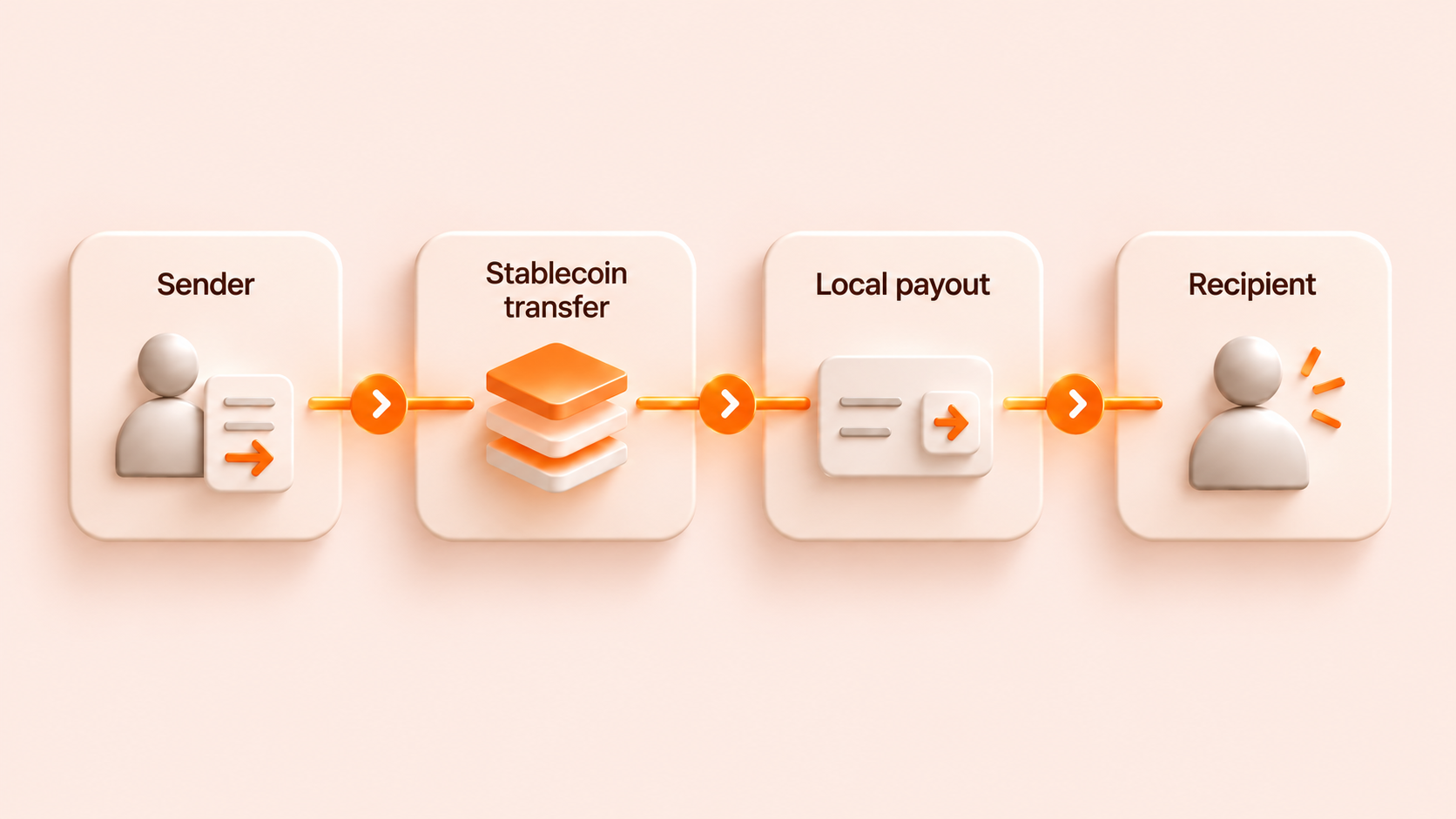
- A payout passes through six steps: funding, verification, quote, conversion, local credit and confirmation. The money sits with a different party at different steps, and you should know who.
- "Settlement" describes three separate events: on-chain finality, conversion, and the credit to the recipient's account. Only the first reliably happens in seconds.
- The domestic rail sets the final clock. A SEPA Instant payment must be credited within ten seconds. A UK Bacs payment settles at 09:30 on processing days only.
- A stablecoin payout changes how money crosses the border. It does not remove the destination country's rules on verification, reporting or tax.
Understanding stablecoin payouts
A stablecoin is a token that tracks a fiat currency, like the US dollar, and is backed by reserves the issuer holds. A stablecoin payout uses that token to move value across a border instead of routing it through a chain of correspondent banks.
What happens at the far end is where the term splits into two different products. Most published definitions describe only the first.
|
Paid in stablecoins |
Paid from stablecoins |
| What the recipient receives |
Stablecoins in a wallet |
Local currency in a bank account or mobile wallet |
| Who converts to local currency |
The recipient, through a service they choose |
The payout provider, before delivery |
| What the recipient needs |
A wallet and access to a conversion service |
A bank account, as for any domestic payment |
| When the exchange rate is set |
Whenever the recipient decides to convert |
When the sender confirms the payout |
| What the recipient's bank sees |
A deposit from a conversion service, if and when they convert |
An incoming domestic payment |
| Best fit |
Recipients who want to hold dollars |
Suppliers, contractors and staff with local bills to pay |
The difference is not cosmetic. Paid in stablecoins, the recipient takes on the conversion, the exchange rate risk, and the job of explaining the deposit to their own bank. Paid from stablecoins, the sender's provider carries all three, and the recipient experiences an ordinary bank payment.
For most business payments, the second version is the one that matters. A supplier in Manila or an accountant in Amsterdam pays rent, salaries and tax in local currency, not in tokens.
How a stablecoin payout works, step by step
The sequence below describes the paid-from version, where the recipient receives local currency. The column worth reading twice is the third one.
| Step |
What happens |
Who holds the money |
| 1. Funding |
You send stablecoins to your payout provider. The blockchain confirms the movement |
The provider, from confirmation onward |
| 2. Verification |
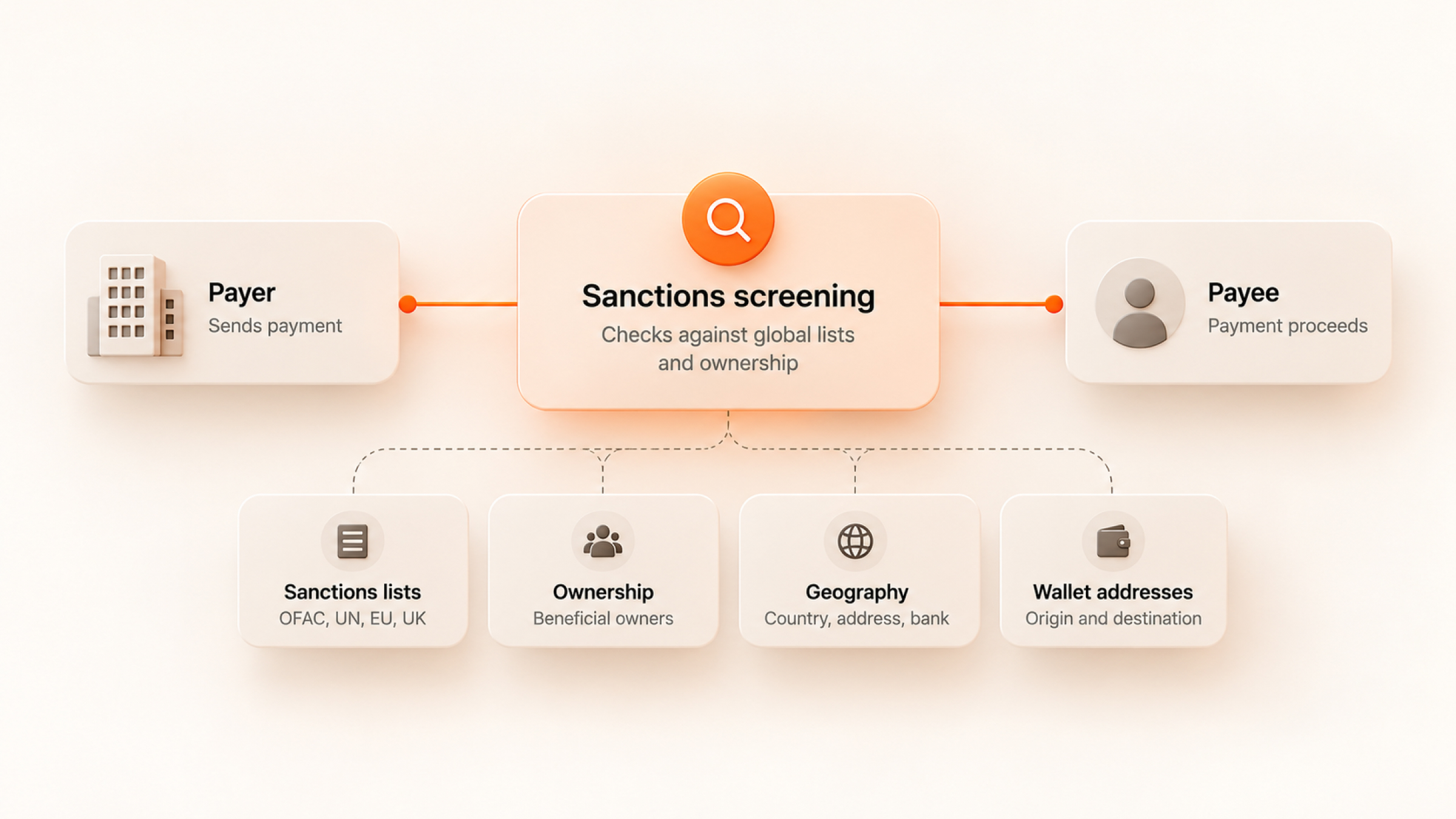
The provider runs sanctions screening on the payment and checks the beneficiary details against what your onboarding established |
The provider |
| 3. Quote |
The provider quotes an exchange rate into the destination currency, and you confirm |
The provider |
| 4. Conversion |
The provider exchanges stablecoins for local currency through a licensed partner in the destination market |
The provider or its conversion partner |
| 5. Local credit |
A licensed institution in the destination country pays the beneficiary over a domestic rail |
The local institution, until the beneficiary's bank credits the account |
| 6. Confirmation |
You receive confirmation that the beneficiary has been paid, with the record of the payment |
The beneficiary |
Two things follow from that table.
Between steps one and five, your money is not in your wallet and not yet in your beneficiary's account. It sits with the provider and its partners. Before sending a first payout, ask who holds the funds during that window, how they are custodied, and what happens to them if a payout fails.
Your own verification happens once, at onboarding, through KYB. The checks in step two run on every payment, which is why a correctly onboarded business can still see an individual payout held for review.
What settlement means in a stablecoin payout
"Settles in seconds" is the most repeated claim in this category, and it is true of one step out of six.
A stablecoin payout contains three separate settlement events.
On-chain finality. The blockchain confirms that the stablecoins moved from your wallet to your provider. This is the step that takes seconds or minutes, and it is the step that removes correspondent banks from the cross-border leg. There is no chain of intermediaries each holding the payment and each taking a fee.
Conversion. The provider exchanges the stablecoins for local currency. The speed here depends on the provider's liquidity in that currency, not on the blockchain.
Local credit. A domestic institution pays the beneficiary over a domestic rail. The beneficiary's bank credits the account. This is the only event the recipient sees, and it runs on the rail's schedule.
When a provider says a payout settles instantly, ask which of the three events they mean. The honest answer usually names the rail.
The local rail sets the final clock
Every market runs at least two domestic rails: one that operates around the clock, and one that runs on banking hours or in batches. Which one carries the last step of your payout decides whether the money arrives in seconds or on the next banking day.
| Market |
Always-on rail |
Business-hours or batch rail |
| United States |
FedNow, operated by the Federal Reserve, which moves payments in real time, around the clock, every day of the year |
ACH. Same Day ACH uses three settlement times each banking day, and standard credits settle the same day, the next banking day, or two banking days out |
| United Kingdom |
Faster Payments, operated by Pay.UK, near real time at any hour |
Bacs Direct Credit, which settles at 09:30 on processing days, with Saturdays, Sundays and bank holidays excluded |
| European Union |
SEPA Instant Credit Transfer. Funds must be credited within ten seconds, at any hour. Eurozone payment providers have had to receive instant payments since 9 January 2025 and send them since 9 October 2025 |
Standard SEPA credit transfer, processed on business-day cycles |
| United Arab Emirates |
Aani, operated by Al Etihad Payments, processing transactions in under ten seconds, 24/7, up to AED 50,000 per transaction |
UAEFTS, the central bank system carrying larger dirham payments, which settles in real time but only within its business hours |
| Philippines |
InstaPay, real-time, up to PHP 50,000 per transaction. Registered business accounts can send up to PHP 500,000 at participating institutions since 29 July 2026 |
PESONet, batch, credited the same banking day if sent before the cut-off |
| India |
RTGS, real-time gross settlement for high-value payments |
NEFT, settled in 48 half-hourly batches every day since 16 December 2019 |
Two patterns run through that table. Always-on rails usually carry a transaction ceiling, which is why large payments fall back to the slower rail. And a rail that settles in real time is not the same as a rail that is open all the time, which is what separates UAEFTS from Aani.
Here is what it means for one payment.
A company pays a contractor in Manila PHP 120,000 at 5:00 PM on a Friday. The stablecoin leg confirms within minutes.
If the provider credits over InstaPay for Business, PHP 120,000 sits well inside the PHP 500,000 business ceiling, and the contractor sees the money in seconds, on a Friday evening.
If the provider can only use standard InstaPay, PHP 120,000 against a PHP 50,000 ceiling means three separate transfers: PHP 50,000, PHP 50,000 and PHP 20,000.
If the provider uses PESONet, 5:00 PM is past the 4:00 PM cut-off at some banks, and PESONet credits on banking days only. The contractor is paid on Monday.
Same token, same minute, and a gap of nearly three days. The blockchain did its part in minutes every time. The rail decided the rest.
Why businesses pay from stablecoins
Three reasons hold up under scrutiny.
Cost. Sending money across borders through traditional channels typically costs 3 to 6 per cent of the amount sent, much of it absorbed by intermediaries and exchange-rate markups. Removing correspondent banks from the cross-border leg removes the fees they charge. The full comparison, line by line, is in the true cost of one payout.
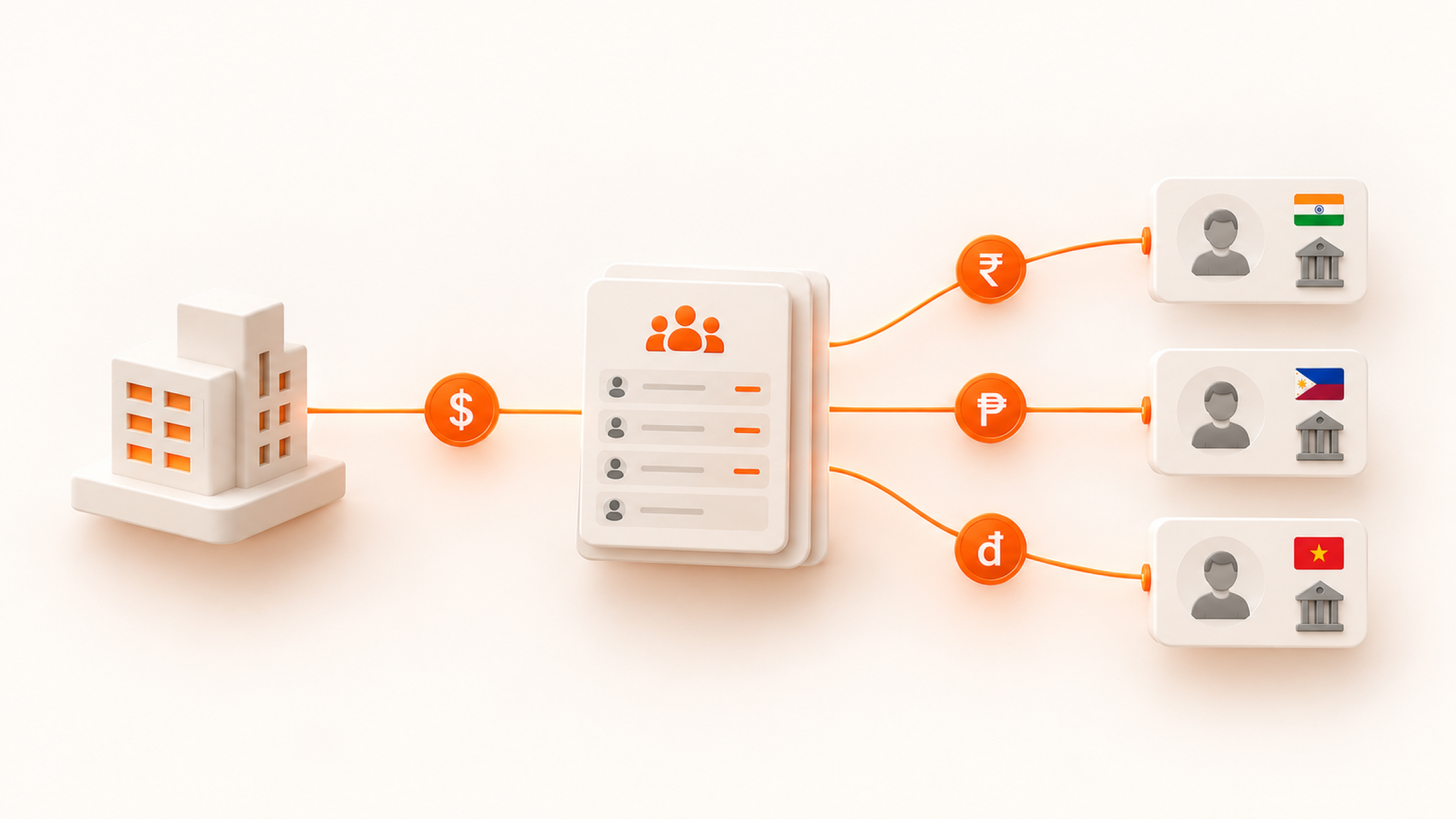
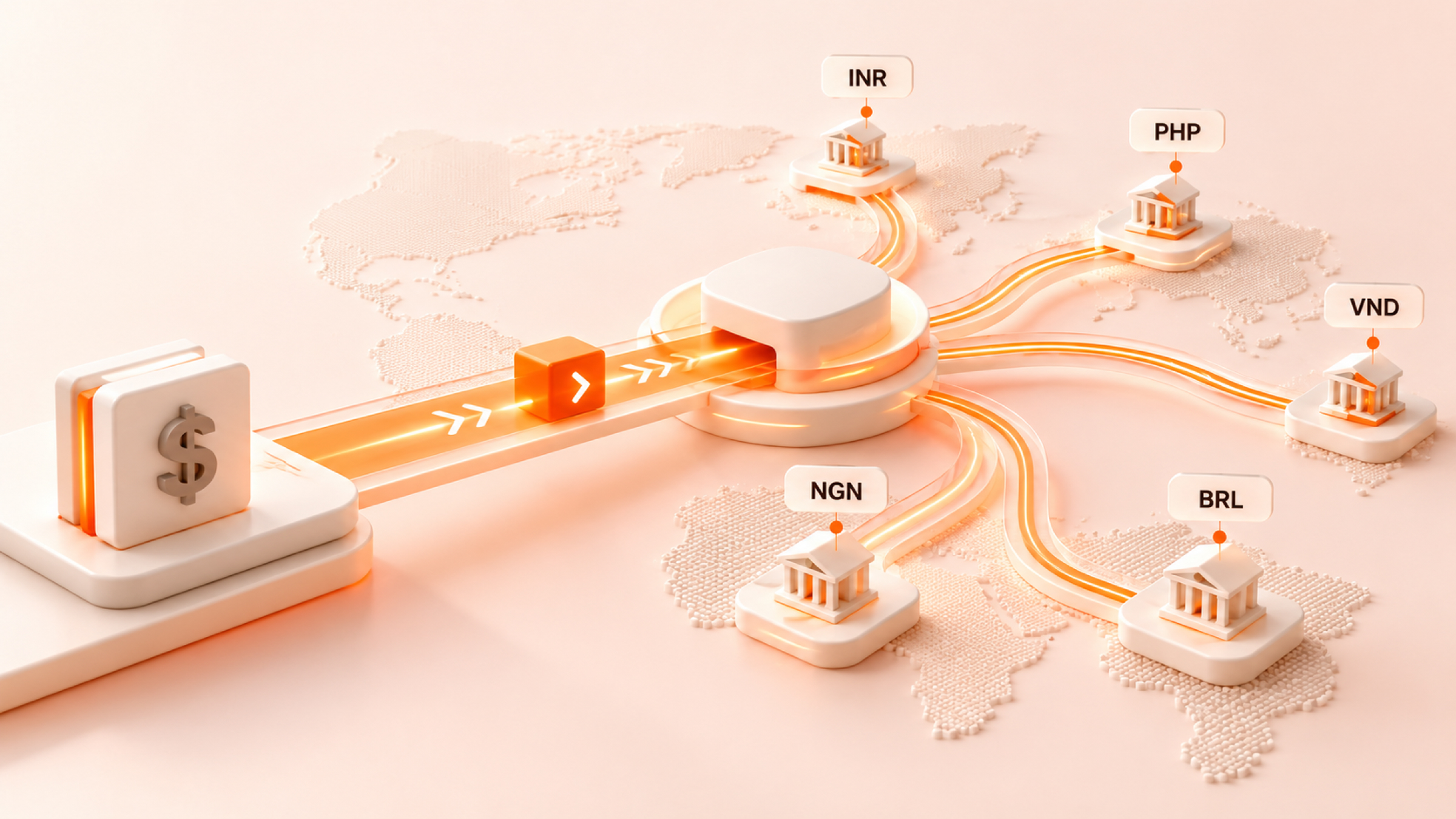
No prefunded balances. A traditional payout operation holds money in advance in each destination currency so that payments can go out on time. Paying from stablecoins lets one dollar-denominated balance fund payments into many currencies, converted at the moment of payment rather than parked weeks ahead.
A funding leg that does not close. The blockchain runs on weekends and holidays. Whether the final credit does depends on the destination rail, as the section above shows.
The trade-offs are real. You depend on your provider's custody between funding and delivery, on its conversion partners in each market, and on which domestic rail it can access. A provider with access only to batch rails will deliver more slowly than the blockchain suggests.
What a stablecoin payout does not change
The destination country still decides whether a payment is permitted, what the beneficiary's bank must check, and how the payment is recorded. A stablecoin payout changes how value crosses the border. It does not move the payment outside that country's rules.
Paid in stablecoins, those obligations land on the recipient, who has to convert the tokens and explain the deposit to their own bank and tax adviser. Paid from stablecoins, they are carried by the licensed institution that makes the local credit.
How those rules differ across the United States, the European Union, the United Arab Emirates, Singapore, the Philippines and India is covered in are stablecoin payment rails actually compliant.
How zPayments handles a stablecoin payout
zPayments runs the paid-from model. You fund in stablecoins, and your beneficiary receives local currency in their bank account, with stablecoin payouts to 171 countries.
Settlement is instant across supported corridors, and next business day where the local rail clears on a cycle, which is the Friday example above in one line. You see one stated rate, quoted before the payment is sent and unchanged when it lands. Screening runs on the platform rather than on the sender, and zPayments is registered as a Money Services Business with FINTRAC.
Start with zPayments.
What to confirm before your first payout
- Which version your recipient needs. Tokens in a wallet, or local currency in a bank account. Most business recipients need the second.
- Who holds the money between funding and delivery. Ask how it is custodied and what happens if a payout fails.
- Which rail makes the final credit, and its cut-off. This decides whether your payout lands in seconds or on the next banking day.
- What record comes back. A confirmation your finance team can reconcile, and a payment your beneficiary can explain to their bank.
Read next: Are stablecoin payment rails actually compliant and The true cost of one payout
Last reviewed: 22 September 2026.