B2B Cross-Border Payments: A Guide for Finance Teams
Key highlights
- The landed amount, not the advertised fee, shows what B2B cross-border payments cost.
- In 2025, the Financial Stability Board (FSB) found fewer than 45% of business-to-business payments credited within one business day.
- Foreign exchange is the largest cost component, and it sits inside the rate.
- The Financial Action Task Force's revised Recommendation 16, due by end-2030, changes the data that travels with cross-border payments.
- A CFO can value a change of route per corridor on four lines: landed amount, deductions, working capital and operating hours.
A finance team paying suppliers in India, contractors in the Philippines and a subsidiary in Japan runs three payments, each with its own rate, route and paperwork. The invoice amount is fixed. What lands is not.
This guide covers how B2B cross-border payments work, where cost and delay enter, which rules apply and how a CFO measures the return on changing the route.
B2B cross-border payments are payments between businesses in different jurisdictions, usually involving a currency conversion and more than one payment system.
International vendor payments are the B2B cross-border payments a business makes to its suppliers, contractors and service providers abroad.
Landed amount is the sum credited to the recipient's account in local currency after every fee, deduction and conversion.
How do B2B cross-border payments work?
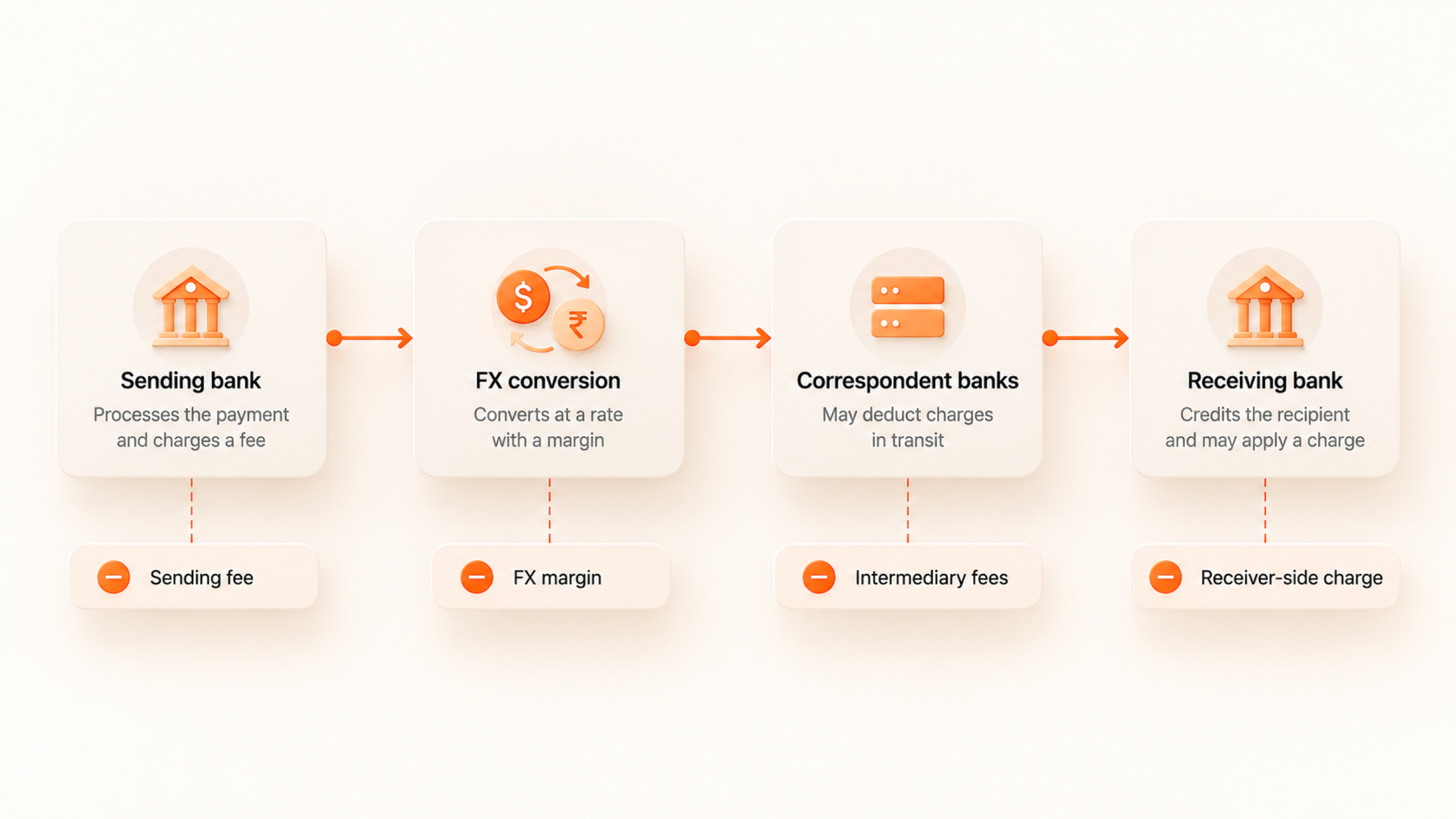
Every cross-border business payment passes through four stages, and each can take a share of the amount sent.
- Instruction. The payer's bank or provider accepts the order and charges a sending fee.
- Conversion. The amount converts at a rate that includes the provider's margin.
- Routing. Where the two banks have no direct relationship, correspondent banks carry the payment and can deduct charges in transit.
- Delivery. The receiving bank credits the recipient through the local payment system and may apply an inward charge.
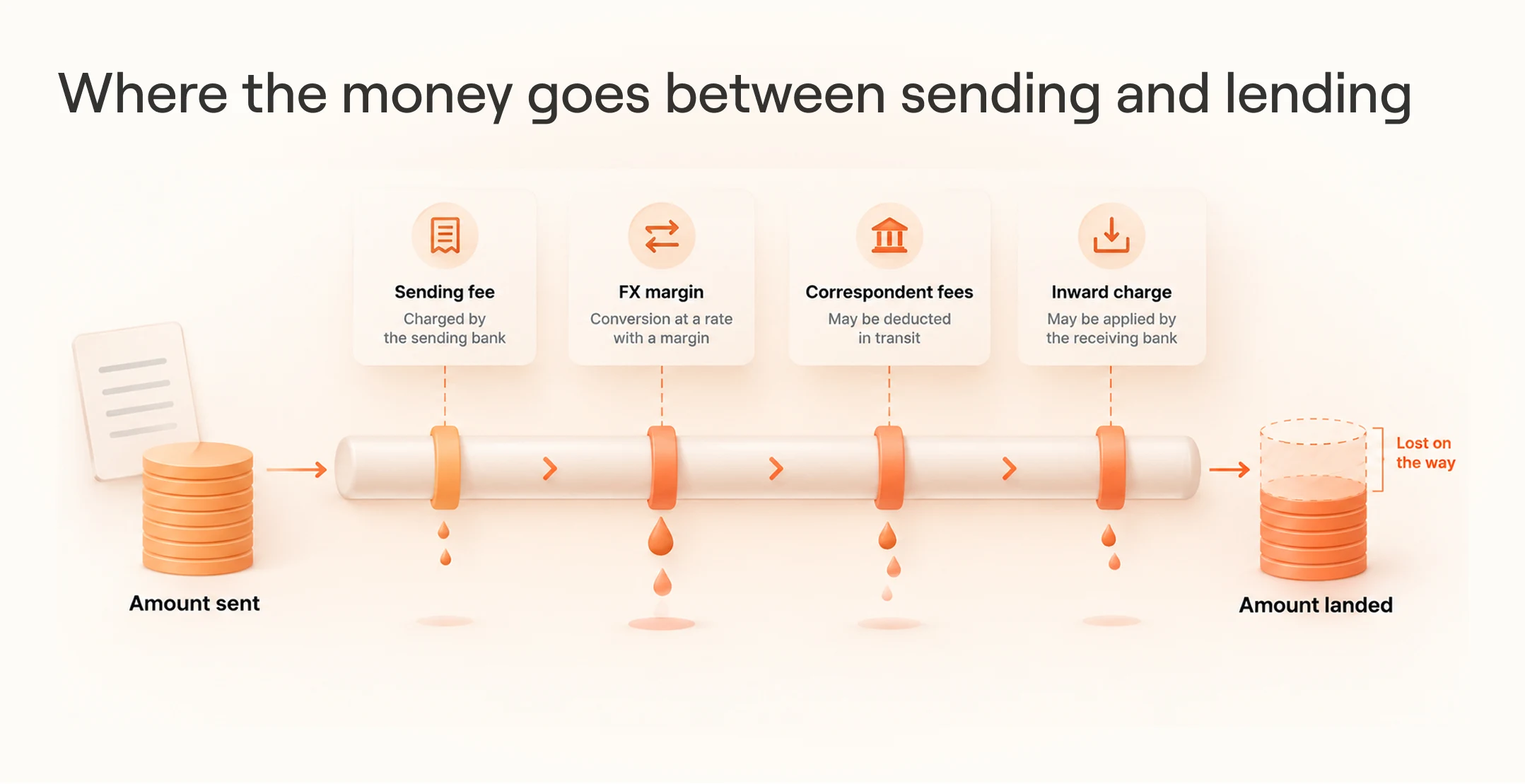
Only the sending fee appears on the payer's statement. The other three show up as less money on the recipient's side.
Why are B2B cross-border payments slow and expensive?
The payment chain itself is the cause. The FSB's Stage 1 assessment for the G20 found seven underlying frictions: fragmented data formats, complex compliance checks, limited operating hours, legacy technology, long transaction chains, funding costs and weak competition.
The G20 targets for end-2027 call for a global average cost of 1% or less, no corridor above 3% and 75% of payments credited within an hour. The FSB's 2025 progress report measures business-to-business payments on a $20,000 transfer. It shows how far B2B cross-border payments still sit from those targets:
- Fewer than 45% of business-to-business payments were credited within one business day.
- From North America, fewer than 3% were credited within an hour, and average costs sat at or above 3%.
- The FSB judged satisfactory improvement by the 2027 deadline unlikely.
What do B2B cross-border payments cost?
Beyond the sending fee, three costs sit between the amount sent and the landed amount. None shows on the payer's statement.
FX spread
The FSB identifies foreign exchange as the largest cost component. The provider converts below the mid-market rate and keeps the difference, so the margin on international vendor payments sits inside the rate.
Intermediary deductions
Correspondent banks take their fees from the principal in transit. Under the common default charge code, the supplier absorbs them and receives less than the invoice amount.
Receiver-side charges
The supplier's bank can also charge on arrival. The FSB's 2025 survey of payment providers put these costs at 0.1% to 1.3% of the amount sent, plus 0.7% to 1.1% in FX margin where that bank converts.
Further reading: FX spread, intermediary bank fees and true payout cost.
Compliance and documentation in B2B cross-border payments
Two global standards are changing the data that travels with a business payment.
The Financial Action Task Force (FATF) revised Recommendation 16 in June 2025. It standardises originator and beneficiary information, assigns responsibility along the payment chain and requires tools that verify a payment reaches the intended recipient. Full implementation is due by end-2030.
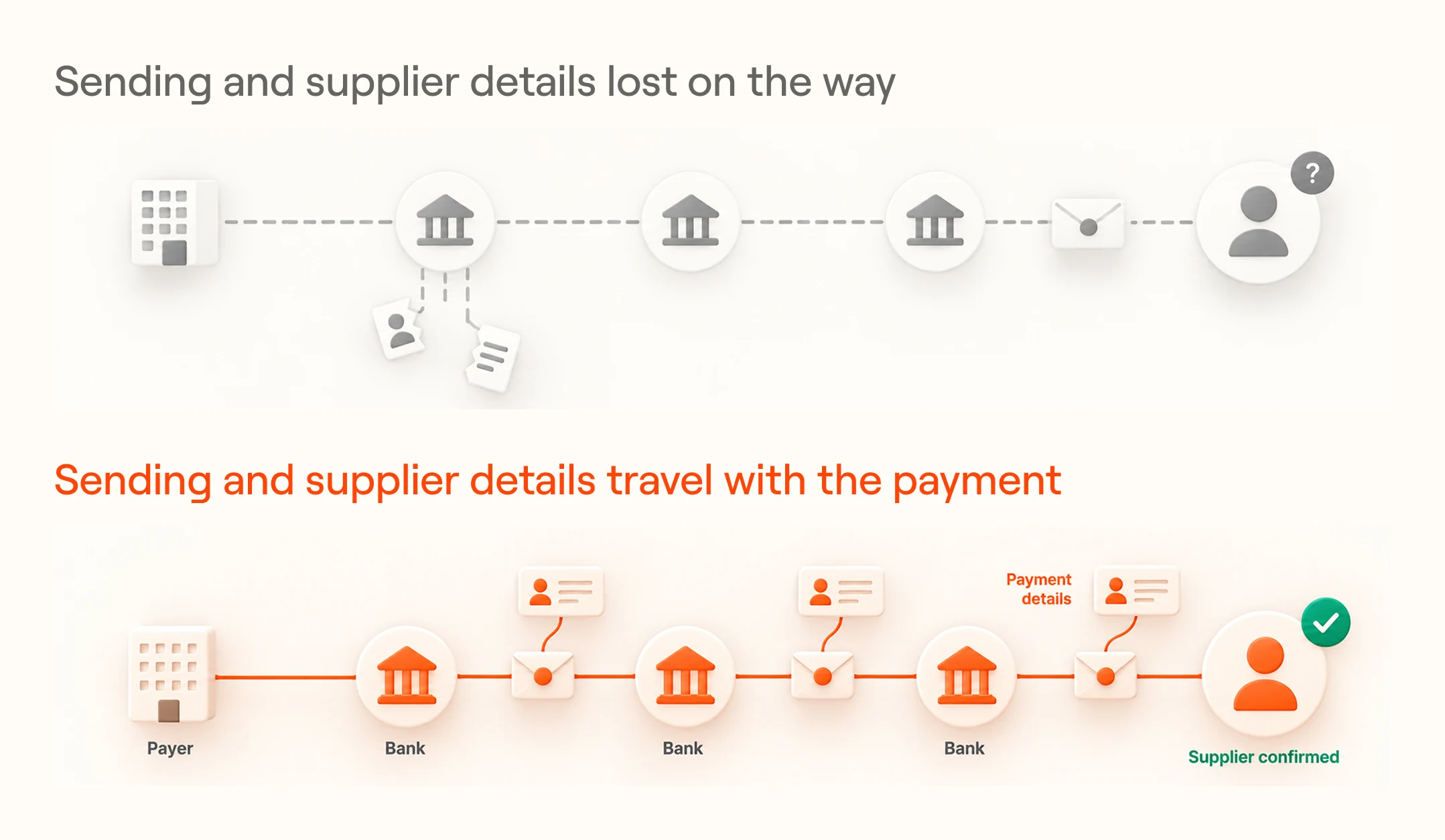
The CPMI, a payments committee of the Bank for International Settlements, set common ISO 20022 requirements for cross-border payment messages. It encourages adoption by end-2027.
Destination rules add a third layer. A payment into India, for example, needs a Reserve Bank of India purpose code, and other countries set their own document rules.
How should finance teams measure international vendor payments?
Five steps turn international vendor payments from an estimate into a measured cost. Start with the three highest-volume corridors.
- Compare what the supplier received. Send the same amount through each route on the same day and record what reached the supplier. The difference shows which route costs more.
- Confirm the rate up front. Get the exact rate and the supplier's amount before approving each payment, then check that the same rate was applied.
- Name the local rail for each corridor. Ask which domestic system delivers the funds in each country and when it settles. That decides when the supplier is paid.
- Check the supplier's paperwork. Confirm that the supplier's bank issues the record needed for tax and export filings.
- Match every payment to its invoice. Each payment should leave one record tied to its invoice. Payout data spread across several systems makes this match manual.
An ROI framework for B2B cross-border payments
A CFO values a route change per corridor on four lines.
| ROI line | How the CFO measures it | What Zoth Payments Limited changes |
|---|---|---|
| Landed-amount gain | Landed-amount difference ÷ amount sent × annual corridor volume | One disclosed rate, quoted with the recipient amount before approval |
| Deductions avoided | Short-paid invoices a year × cost to resolve each | No correspondent chain between payer and recipient |
| Capital released | Days in transit × daily payout value × cost of capital | Local delivery timing stated per corridor before sending |
| Hours saved | Monthly hours on investigations and reconciliation × hourly cost | Every payout tracked, with records exportable for reconciliation |
Annual return per corridor = landed-amount gain + deductions avoided + capital released + hours saved
On a corridor carrying $750,000 a month, landing 0.4% more of each payment adds $36,000 a year.
How zPayments handles B2B cross-border payments
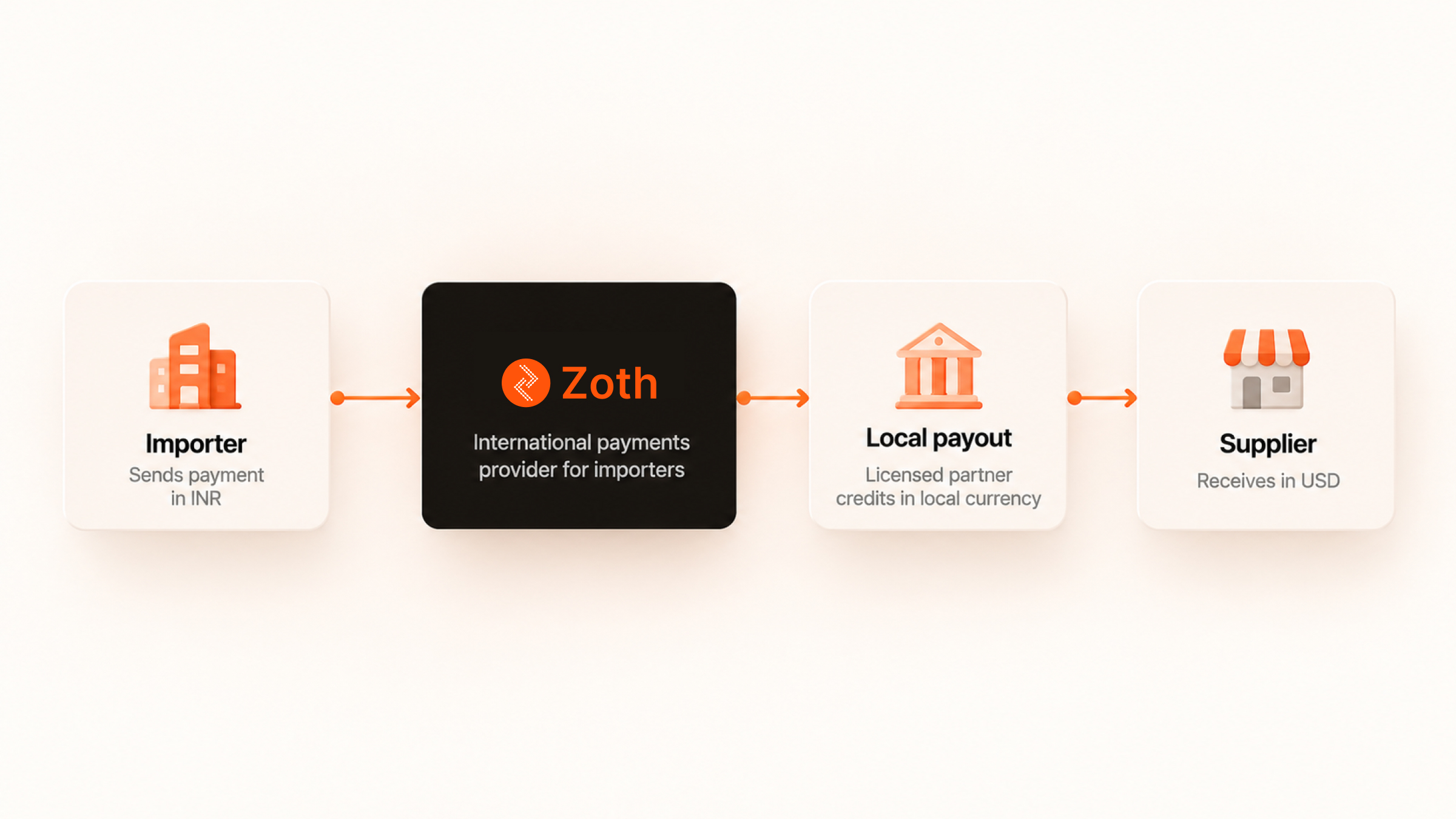
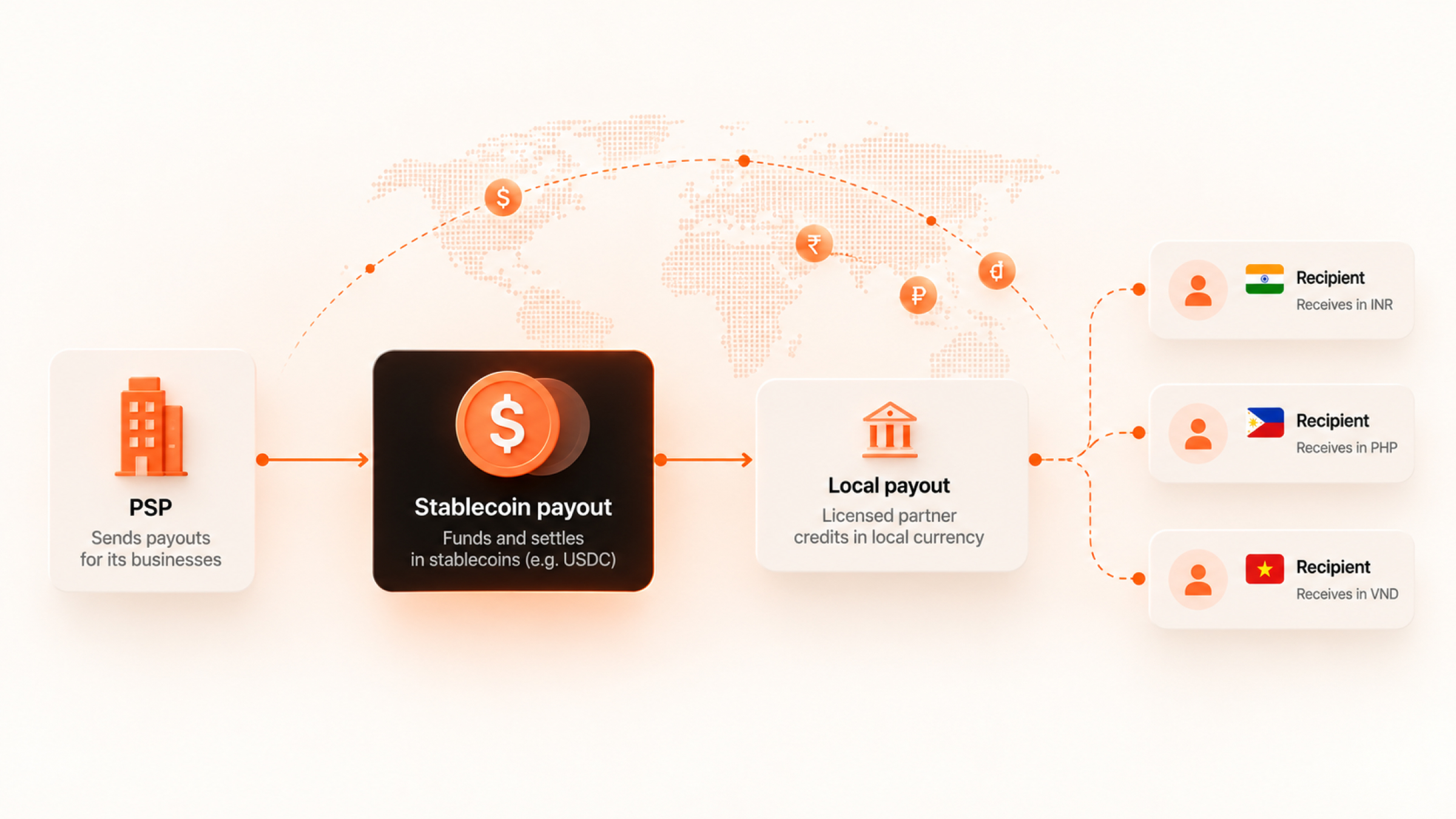
Zoth Payments Limited, registered as a money services business with FINTRAC, runs zPayments for business payouts. Value moves on stablecoin rails and lands in local currency through licensed partners in each corridor, with no correspondent chain in between. Screening, travel rule checks and monitoring run inside the platform.
The framework's first line needs one number: what the recipient would receive today. The zFX live rate calculator shows the rate and the recipient amount for a chosen corridor and amount. Comparing it with the last amount the recipient confirmed gives the landed-amount gap. Start with last month's largest supplier payment.
Running B2B cross-border payments into emerging markets? Audit your cross-border payout fees with zPayments today.
Frequently asked questions
What are B2B cross-border payments?
Payments between businesses in different countries, usually with a currency conversion, covering supplier invoices, contractor fees, intercompany transfers and royalties.
How long do B2B cross-border payments take?
Most take longer than one business day. The FSB's 2025 data shows fewer than 45% of business-to-business payments credited within that window.
What is the largest cost in international vendor payments?
The FX margin, which the FSB identifies as the largest cost component. It sits inside the rate.
What does FATF Recommendation 16 change for business payments?
It standardises payment message data, assigns responsibility along the payment chain and requires recipient verification. Implementation is due by end-2030.
How should a CFO compare providers for B2B cross-border payments?
On the landed amount: the same amount, sent on the same day, measured in the recipient's currency.